

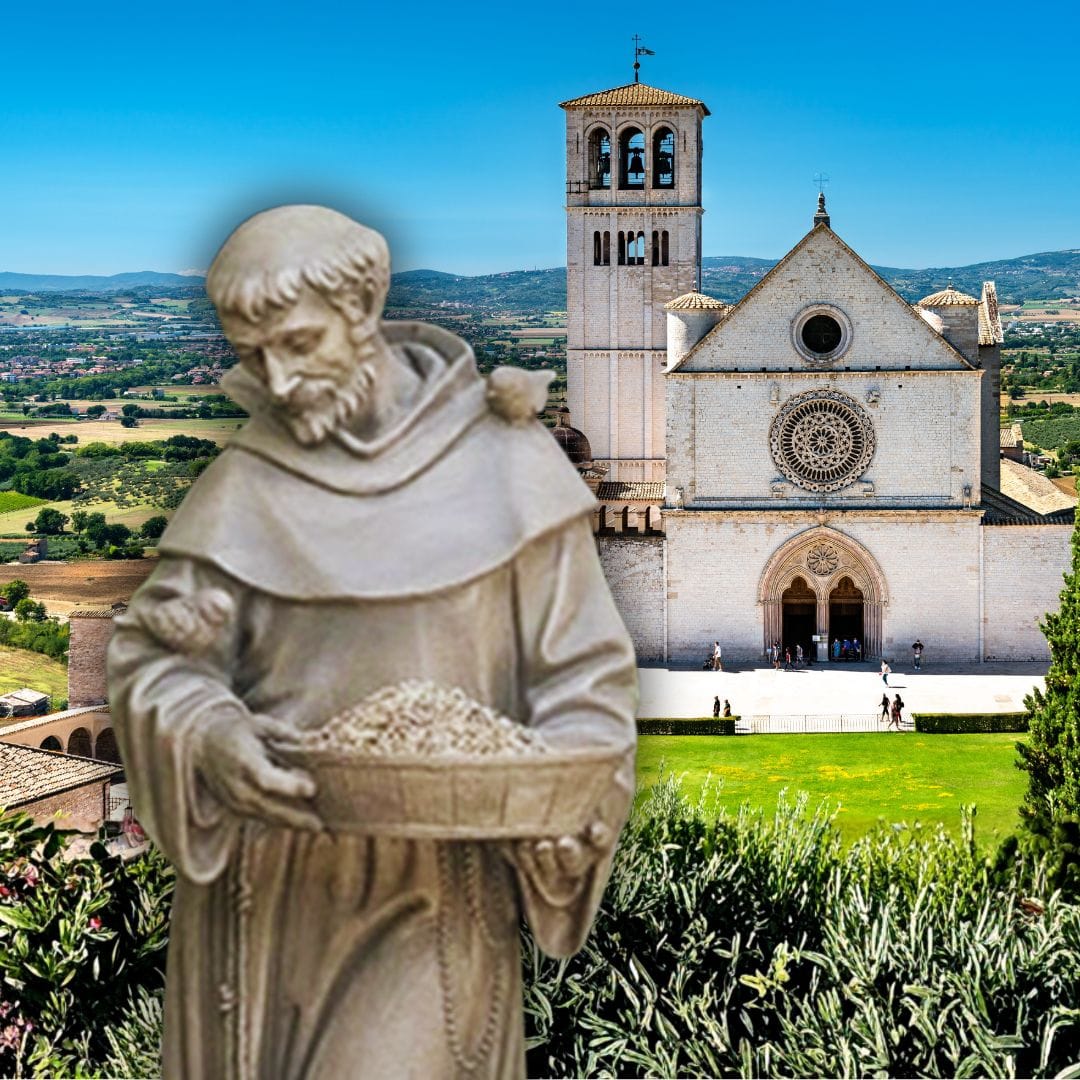
On January 10, 2026, Pope Leo XIV inaugurated the “Special Year of Saint Francis.” This special Jubilee Year commemorates the 800th anniversary of Saint Francis of Assisi’s death.
During this Jubilee Year, Catholics have the opportunity to receive a plenary indulgence.
EWTN Vatican reported,
“This Franciscan Jubilee Year, considered a gift for the entire Church and an occasion for authentic spiritual renewal, was inaugurated on Jan. 10 with a decree issued by the Apostolic Penitentiary of the Holy See.
“Until Jan. 10 of next year, the faithful can obtain this grace under the usual conditions — sacramental confession, Communion, and prayer for the intentions of the pope — by making a pilgrimage to any Franciscan conventual church or place of worship dedicated to St. Francis anywhere in the world.”
Saint Francis of Assisi is one of the Church’s best-known and most beloved saints.
During this Franciscan Jubilee Year, let’s learn more about Saint Francis of Assisi. Here are 12 fascinating facts about his amazing life:
1) Saint Francis of Assisi grew up as one of seven children.
Born in Assisi around 1181, Saint Francis was raised in a large, wealthy family, enjoying a comfortable childhood before his dramatic conversion.
2) The name “Francis” reflects his father’s love for France.
Although baptized Giovanni, his father renamed him Francis, or Francesco, which means “Frenchman.” His father was a merchant who admired French culture.
3) Saint Francis of Assisi was held as a prisoner of war for a year.
As a young 19-year-old man, Francis fought in a conflict against the city of Perugia before his conversion. He was captured and imprisoned for nearly a year—an experience that deeply shaped his spiritual conversion.
4) A verse from the Gospel of Matthew inspired Saint Francis’ radical poverty.
Matthew 10:9, in which Jesus instructs His disciples to take nothing for their journey, became the foundation for Saint Francis of Assisi’s embrace of poverty and itinerant preaching.
5) Saint Francis of Assisi gathered 11 followers within one year.
Within a short time, Francis attracted 11 companions, forming the early Franciscan community and mirroring the 12 Apostles of Christ.
6) Pope Innocent III approved the Franciscan Order after having a supernatural dream.
According to tradition, Pope Innocent III dreamed of Saint Francis holding up the Archbasilica of Saint John Lateran. This vision convinced him that the Franciscans would help renew and support the Church.
7) Saint Francis of Assisi attended the Fourth Lateran Council and met Saint Dominic.
In 1215, Francis was present at the Fourth Lateran Council, one of the most significant Church councils, where he encountered Saint Dominic, founder of the Dominican Order.
8) Saint Francis of Assisi preached the Gospel to a Muslim sultan during the Crusades.
During the Fifth Crusade, Francis crossed enemy lines to meet Sultan al-Kamil of Egypt, boldly proclaiming the Christian faith and even proposing a trial-by-fire to witness to Christ.
The trial-by-fire consisted of Saint Francis and a Muslim stepping into a fire, with the idea that God would spare the follower of the true religion. Francis offered to go first, but the Sultan turned down the challenge. Nonetheless, the Sultan was so impressed by his faith that he permitted Francis to preach in his land.
9) Saint Francis of Assisi prayed for miracles to cease at a friar’s tomb.
After the death of Franciscan leader Peter Catani, reported miracles drew overwhelming crowds, causing problems. Francis prayed, asking Peter to stop the miracles, and the miracles stopped.
10) Saint Francis of Assisi received the stigmata during a 40-day fast.
In 1224, while fasting in preparation for the Feast of Saint Michael the Archangel, Saint Francis became the first recorded saint to receive the stigmata—the wounds of Christ.
The Franciscan, reportedly with him when it occurred, said,
“Suddenly, he saw a vision of a seraph, a six-winged angel on a cross. This angel gave him the gift of the five wounds of Christ.”
11) Construction of the Basilica of Saint Francis of Assisi began immediately after his canonization.
Francis died on October 3, 1226. Pope Gregory IX declared him a saint on July 16, 1228, and the next day, the Pope personally laid the foundation stone for the new Basilica of Saint Francis of Assisi, less than two years after his death.
12) The tomb of Saint Francis of Assisi was hidden and rediscovered centuries later.
To protect his remains from invasion, the Franciscans concealed his tomb. Its location was forgotten until it was rediscovered in 1818.