

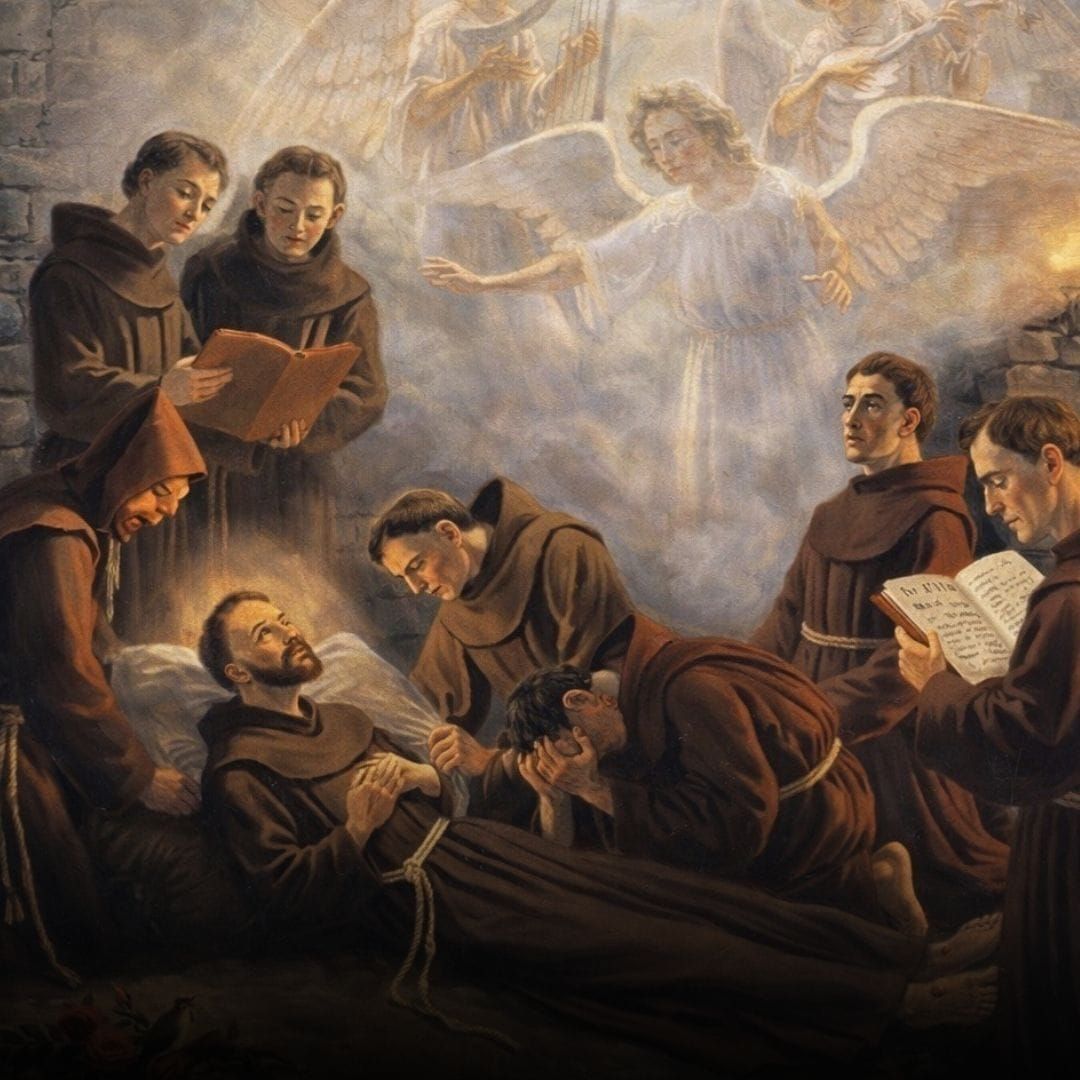

This year, the Church commemorates the 800th anniversary of the death of Saint Francis of Assisi (1226–2026), a special occasion to look back at the life and witness of the “Poverello.”
In Assisi, his mortal remains—normally kept in the crypt of the basilica—have been exceptionally displayed for the veneration of the faithful during this Jubilee Year, inviting pilgrims to deepen their understanding of his spiritual journey and his profoundly Christian way of facing death.
In this context, reflecting on how Saint Francis lived his Transitus—his “passage” to the House of the Father—is not merely a beautiful historical detail: it is a living catechesis on how a Christian can face death without fear and with total trust in God.
1) The Church gave a special “name” to the day of his death: the Transitus.
Saint Francis did not simply die: the Church calls his departure the Transitus, from the Latin word meaning “passage” or “crossing.”
On the afternoon of October 3, 1226, he “passed” from this life into eternal life, and Franciscans around the world still hold a special vigil every October 3 to remember his final hours with readings, hymns, and candlelight.
2) His liturgical feast is actually his “birthday in Heaven.”
We celebrate the feast of Saint Francis on October 4 because it is the day after his death: his dies natalis, his “birth into heaven” or “birthday in heaven.”
As with many saints, the Church honors the day he entered eternal life, not his earthly birthday—reminding us that our true life begins when we see God face to face. In 2025, Italy added this day to its calendar of national holidays.
3) He asked to die in his favorite little chapel.
When Francis realized he was dying, he did not ask for a grand cathedral. Instead, he asked to be taken back to the small chapel of Santa Maria degli Angeli, the Porziuncola.
It was the little church where he had first clearly heard and embraced God’s call, so he wished to return there to “give back” his soul to God in the place where everything had begun.
4) He chose to die completely poor—literally naked on the ground.
True to his radical embrace of poverty, Francis asked the brothers to lay him naked on the ground as he was dying.
He wanted to leave this world possessing nothing, just as Christ died stripped on the Cross, and to show that he trusted only in God’s mercy—not in possessions, honors, or human security.
5) He turned his deathbed into a moment of praise.
Francis’s final days were filled with praise rather than anguish.
He asked the brothers to sing his Canticle of the Creatures, especially the verse about “Sister Death,” and he joined them in praising God as much as he could, even in great pain and nearly blind.
6) He welcomed “Sister Death” aloud.
According to his early biographers, Francis not only wrote about Sister Death—he spoke to her.
As his final hour approached, he is said to have exclaimed: “Welcome, my Sister Death!” receiving his own death as the one who would finally lead him to his Lord.
7) He made his final moments reminiscent of the Last Supper.
Francis wanted his death to reflect the final hours of Jesus. He asked that the Gospel of John be read, beginning with “Before the Feast of Passover,” and he requested bread, blessed it, and shared it with his brothers as a sign of love—a small and humble echo of the Last Supper.
8) He died giving his brothers a final blessing.
Even as his strength failed, Francis thought of his community.
He extended his arms in the form of a cross and blessed the brothers, urging them to love God, remain faithful to the Church, embrace poverty and patience, and persevere in the life they had chosen.
9) “Sister Jacoba” brought him his favorite cookies.
Saint Francis asked his lay friend, Blessed Jacoba de Settesoli, to come and see him—and to bring her almond cookies.
He affectionately nicknamed her “Brother (yes, with an ‘o’) Jacoba” so she could visit the convent without causing scandal. Tradition says that many Franciscans still share almond sweets around the anniversary of his death, remembering that tender and deeply human gesture at the end of his life.
10) He died in pain… but without fear.
At 44, Francis was gravely ill, nearly blind, and marked by the stigmata. Yet he faced death with serenity, convinced that in Christ, suffering and death do not have the final word.
Saint Francis saw death as a path to conversion, detachment, and trust in God. Far from being macabre, the iconography depicting him with skulls carries a biblical meaning: it recalls the fleeting nature of earthly life and the need to live always turned toward the Lord.
Looking at how he prepared for death—united to Christ crucified—we too learn to prepare for our own passing with prayer, the sacraments, penance, charity, and total trust in the mercy of God.