

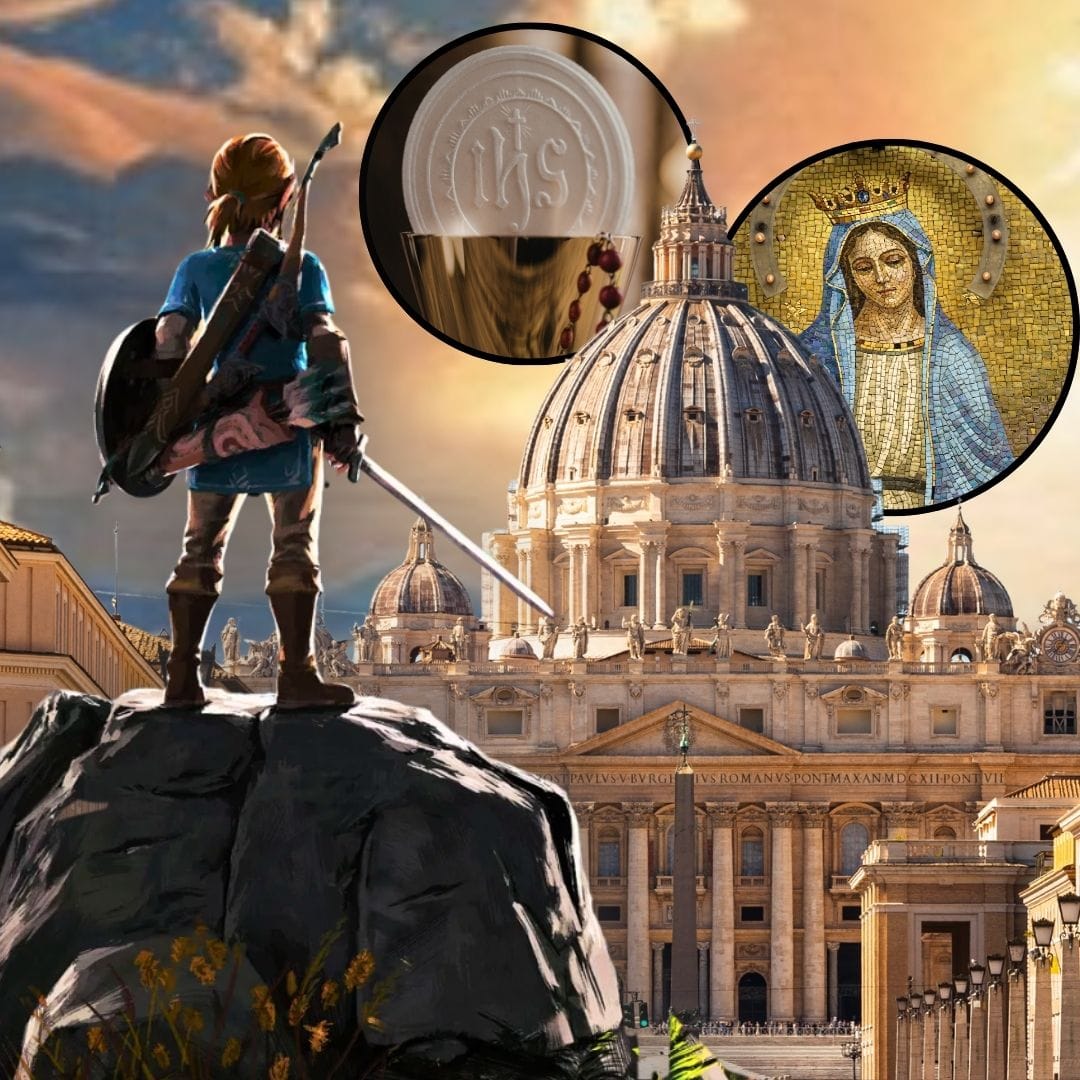

Few video games have captured the imagination of a generation quite like The Legend of Zelda: Ocarina of Time. Released in 1998, it remains one of the greatest video games of all time.
On Metacritic, it holds a score of 99/100, the highest score ever awarded to a video game. But beyond its gameplay, beautiful music, and epic story, Ocarina of Time contains layers of symbolism and storytelling that echo some of the most profound truths of the Catholic faith.
Sacred Time and the Liturgical Year
At the heart of Ocarina of Time is the theme of time itself. Link journeys back and forth between childhood and adulthood using the Master Sword and the Temple of Time. His mission depends on moving within a timeline that is not just linear, but sacred. Time in the game is a tool for redemption, restoration, and growth.
This mirrors the Catholic understanding of time, especially within the liturgical year. The Church doesn’t simply mark time—it sanctifies it. Advent, Christmas, Lent, Easter, and Ordinary Time are not arbitrary seasons, but moments where heaven breaks into earthly time.
The Temple and the Sacred
Throughout the game, Link travels to various Temples—Forest, Fire, Water, Shadow, Spirit, and Light—to conquer evil and restore order. These aren’t just dungeons; they’re sacred places with symbolic significance. Each represents an elemental and spiritual struggle, and Link’s quest within each Temple is marked by purification, trial, and ultimate victory.
Catholic churches, too, are more than buildings. They are Temples of God, spaces in which the divine is encountered and the faithful enter into sacred mysteries. The Temple of Time in the game, which houses the Master Sword, feels particularly resonant: a solemn, quiet place that invites awe and reverence—much like a Catholic sanctuary before the Blessed Sacrament.
The Triforce and Divine Virtue
The Triforce—comprised of Power, Wisdom, and Courage—is the mystical source of balance and harmony in Hyrule. Its misuse brings destruction; its proper balance brings peace. This triad closely resembles key Christian virtues and even the life of the Trinity.
Some interpret the Triforce as a symbol of the three theological virtues: Faith (Power), Hope (Courage), and Charity (Wisdom). In Catholic theology, harmony among the three Divine Persons (Father, Son, and Holy Spirit) is at the heart of holiness and salvation.
Zelda as a Marian Figure
Princess Zelda plays the role of a wise, humble, and sacrificial guide. She works behind the scenes, protecting and directing the hero at key moments. While never dominant or forceful, her influence is quietly powerful.
In many ways, Zelda mirrors the Virgin Mary. She is the handmaid of the kingdom’s salvation, cooperating with divine grace to bring about redemption. Her hidden identity, intercessory role, and final act of self-offering align with Marian theology—Mary as the New Eve, the Ark of the Covenant, and the Queen of Heaven.
Ganondorf as a Luciferian Figure
Ganondorf, the primary antagonist, represents the corruption of power and the desire to dominate. His fall from grace and misuse of the Triforce of Power echoes the fall of Lucifer, the once-glorious angel who rebelled against God and sought his own throne.
In Catholic thought, evil is not an equal force to good—it is a distortion of it. Ganondorf seeks not just power, but the throne of the gods. His lust for control and rejection of harmony place him firmly in the tradition of Satan, whose non serviam (“I will not serve”) echoes in Ganondorf’s rebellion.
Baptism, Trials, and Transformation
In many parts of the game, Link must purify himself—often through water, fire, or shadow—before advancing in his mission. The Water Temple, in particular, has a strong baptismal feel: it is confusing, humbling, and cleansing. Emerging from it, Link is more fit for the battle ahead.
This parallels the Catholic understanding of the sacraments, especially Baptism and Confession. Before we can fight the good fight or receive spiritual gifts, we must be cleansed. Transformation, in the Catholic life, always involves death to self, just as Link must leave behind comfort and childish things to fulfill his destiny.
Conclusion
The Catholic imagination is drawn to stories that echo the deepest truths of the Gospel: sacrifice, redemption, sacred time, virtuous struggle, and the ultimate triumph of good over evil. The Ocarina of Time is a fairy tale in the truest sense: one that reveals the invisible through the visible, and the eternal through the temporal.
Come into the Catholic Church and take on this lifelong quest. Like all good stories, it invites you to take up your sword, face the darkness, and fight for heaven.