

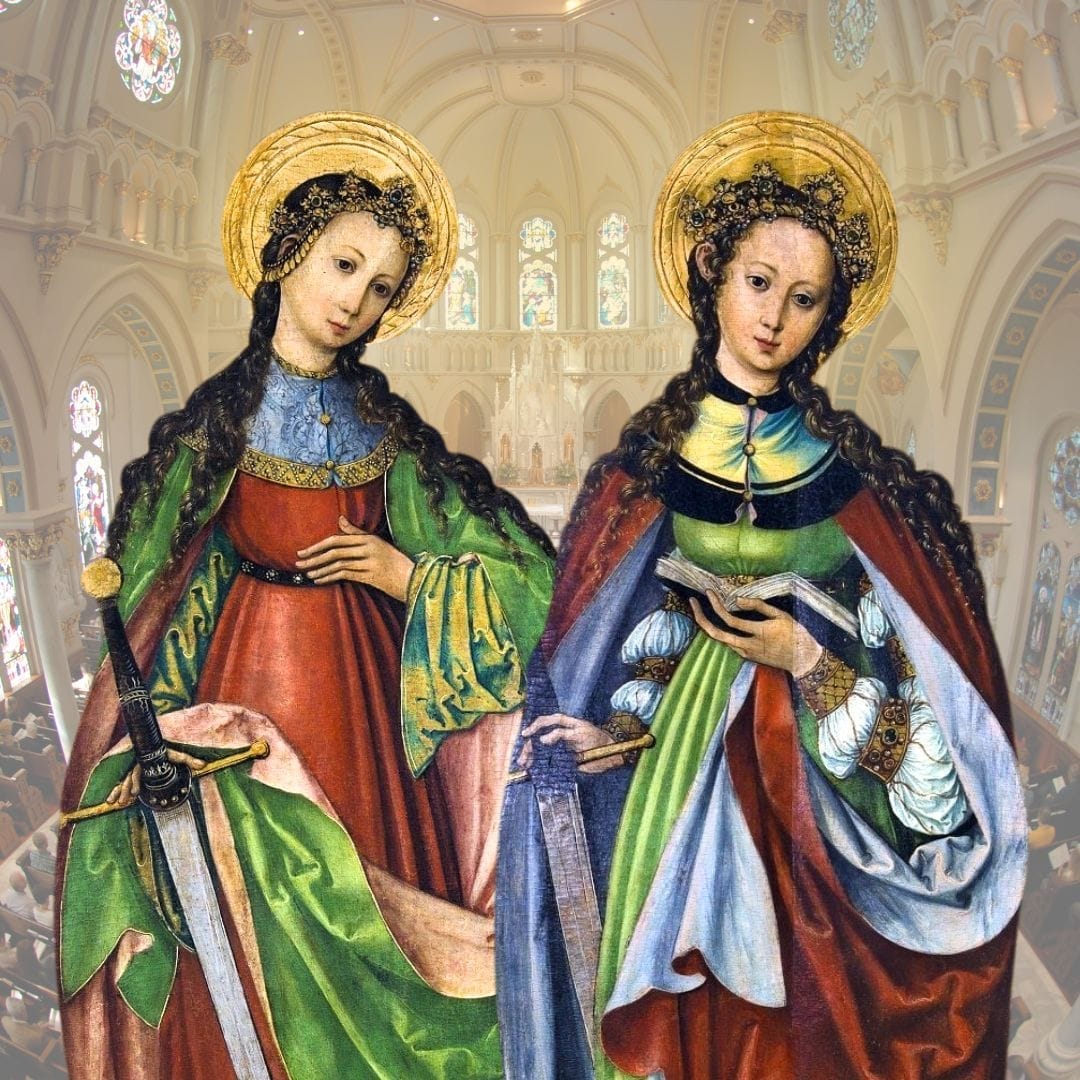
In the early centuries of Christianity, when following Christ could cost you your life, two women whose faith has stood the test of time shone brightly: Saints Perpetua and Felicity.
Their story is not merely an ancient tale of persecution, but a living testament to hope, inner freedom, and unwavering fidelity to God.
Their names are read in the Eucharistic Prayer of the Roman Canon of the Mass because they were two saints deeply venerated in the Early Church. Their testimony was preserved in the Acts of the Martyrs.
Here are some key points to help you understand who these two brave women were:
1) Their historical context.
Perpetua and Felicity lived in the third century in Carthage, North Africa, and were arrested around the year 203 during the persecution of Emperor Septimius Severus for professing the Christian faith.
Perpetua was a young noblewoman and the mother of a small child. Felicity, on the other hand, was her slave and was pregnant. United by faith, they faced martyrdom together.
Other catechumens were also arrested with them, along with their catechist, the deacon Saturus, who had instructed them in the faith and prepared them for baptism. He later voluntarily surrendered himself to share in their fate.
The Acts of the Martyrs recount:
“The young catechumens Revocatus and Felicity, the latter his companion in servitude; Saturninus and Secundulus were arrested, and among them also Vibia Perpetua, of noble birth, educated in the liberal arts, legitimately married, who had a father, mother, and two brothers, one of them a catechumen like herself, and a small child whom she herself fed. She was about twenty-two years old.”
2) The value of faith over fear.
One of the most moving aspects of this story is Perpetua’s diary, one of the oldest surviving Christian texts written by a woman. In it, she recounts her visions, her inner struggles, and the pain of being separated from her son.
Her pagan father repeatedly tried to persuade her to renounce her faith and save her life. But Perpetua responded with serene firmness:
“When we were still among our persecutors,” she writes, “my father ardently desired to make me apostatize with his words, and, driven by his affection, he would not cease in his efforts to bring me down.
‘Father,’ I said to him, ‘do you see that utensil lying there on the ground, a jar or something similar?’‘I see it,’ he replied.‘Can it be called by any other name than what it is?’ 'No,’ he answered.‘Well, neither can I call myself by any other name than what I am: a Christian.’”
3) Strength in weakness.
Felicity gave birth in prison just a few days before her martyrdom.
According to the Acts of the Martyrs, when a prison guard heard her crying out during childbirth, he said to her:
She replied:
“Now it is I who suffer what I suffer; but then there will be another in me who will suffer for me, because I also will suffer for Him.”
She gave birth to a baby girl, whom one of the Christian sisters raised as her own daughter.
4) Their martyrdom and spiritual legacy.
After enduring numerous trials and tortures, both women were taken to the amphitheater and died for their faith.
Felicity's head was severed with a machete blow. The executioner assigned to kill Perpetua, however, was extremely nervous and missed his first strike. Though she cried out in pain, she calmly guided his trembling hand and indicated the exact place on her neck where he should strike.
Even in her final moments, she demonstrated that her martyrdom was embraced freely and courageously.
The Church celebrates their feast day on March 7.
The story of Perpetua and Felicity spread rapidly among Christians, becoming a powerful symbol of:
- faithfulness in the midst of persecution
- equality in faith (a noblewoman and a slave united as sisters)
- Female strength in the early Church
- hope in eternal life despite suffering
Today, Saints Perpetua and Felicity are considered patron saints of mothers and pregnant women.