
Saint Joseph is one of the most important figures in salvation history—and also one of the most mysterious.
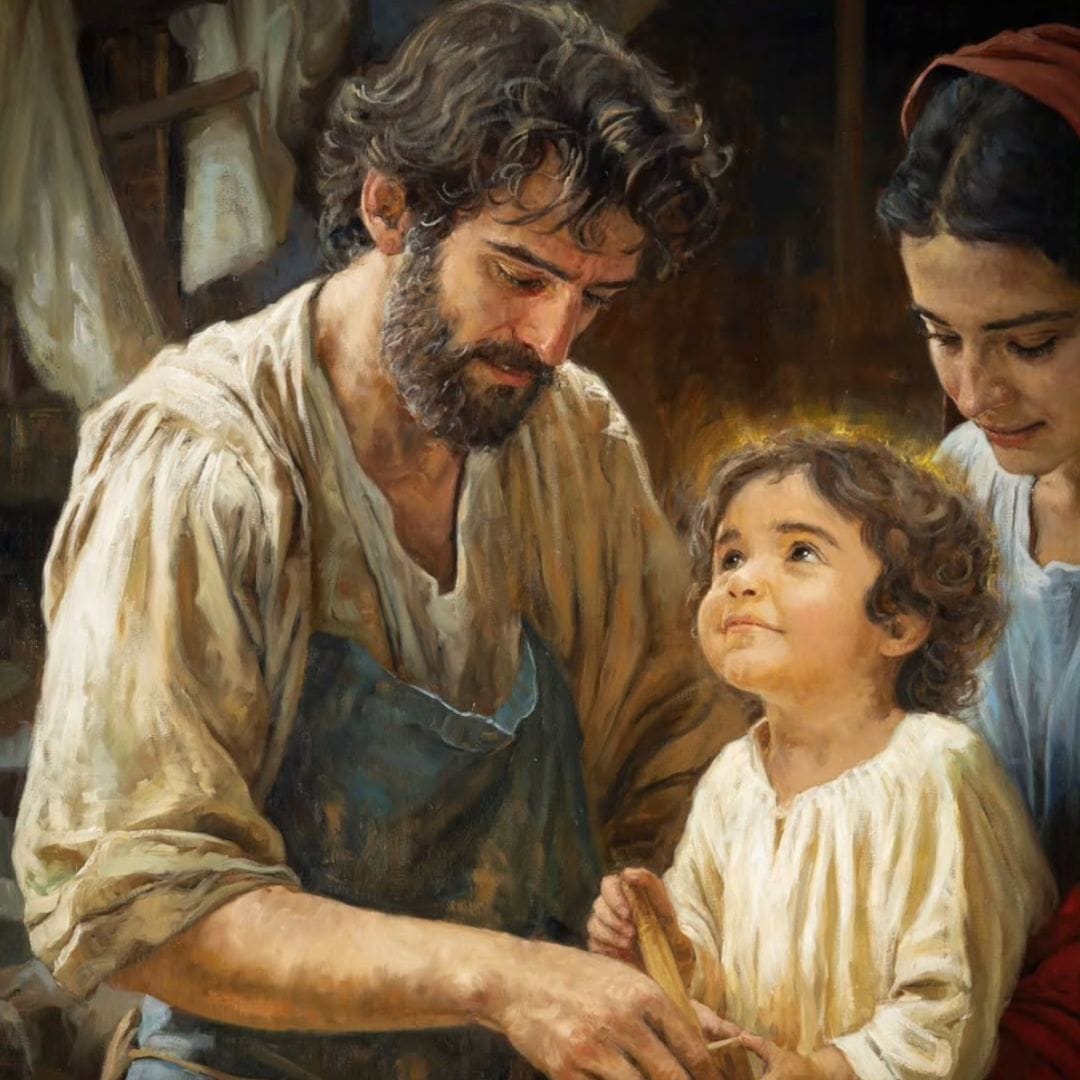
As the foster father of Jesus and the spouse of the Blessed Virgin Mary, he was entrusted with protecting the Holy Family and raising the Son of God. Yet the Gospels record very little about him.
Despite his silence in Scripture, the Catholic Church’s love for Saint Joseph has grown for centuries, for his intercession is incredibly powerful.
As Saint Teresa of Avila said, “Whatever you ask of Saint Joseph, you shall receive.”
In honor of Saint Joseph’s month of March, here are eight fascinating things you might not know about Saint Joseph, the foster-father of Jesus:
1) Saint Joseph has no recorded quoted words in Scripture.
He protected the Immaculate Mother of God and helped raise the Lord of the Universe!
But he doesn’t get even one direct quote. Rather, he’s a silent, humble servant of God who does his task well and no more. Catholic writers often point out that the Gospels report what Joseph did, not what he said, and none of his words are placed in quotation marks, even though Matthew notes that he “did as the angel of the Lord commanded him” and named the child Jesus.
2) Saint Joseph is not mentioned in the Gospel of Mark – or even most of the New Testament.
Joseph is mentioned in Matthew and Luke, particularly in the infancy narratives and the genealogies, and the Gospel tradition also refers to Jesus as “the son of Joseph” in the context of his upbringing. After the early chapters, however, he disappears from the New Testament record. He is not mentioned at all in Mark or in the rest of the New Testament.
3) Saint Joseph’s exit from the story of the Gospels is left unexplained in Scripture.
He’s an important figure in the Nativity narratives of Matthew and Luke, and he is included in the story of finding the 12‑year‑old Jesus with the teachers of the Law in the Temple. But that’s the last we hear of him. Mary comes up several times during Jesus’ ministry, and is present at the Crucifixion, but Joseph is gone without a trace. So what happened to him?
Various traditions explain this gap by saying that Joseph died sometime before Jesus’ public ministry, perhaps when Jesus was a young man, though Scripture itself gives no details, and different authors offer different conjectures.
4) Saint Joseph may have been an old widower.
Scripture doesn’t tell us how old Joseph was when he married Mary, or really anything about his previous life. An early set of apocryphal writings, though, portrays him as an elderly widower who had children from a previous marriage and whose wife had died, leaving him a widower.
In these accounts (for example, in the Protoevangelium of James and in the Gospel of Pseudo‑Matthew), he is explicitly described as older and already a father, and is chosen to be Mary’s husband and protector, knowing of her vow of virginity.
This helps explain why he apparently died while Jesus was a young man, as well as why some people are referred to as Jesus’ “brothers” and “sisters” in the Gospels: they could have been Joseph’s children from a previous marriage and thus were Jesus’ step‑siblings.
These details, however, come from apocryphal and later theological sources, and writers like Saint Jerome preferred another explanation, understanding the “brothers” as close relatives or cousins rather than Joseph’s own children.
5) Veneration of Saint Joseph dates back to the ninth century.
During the Middle Ages, growing devotion to Jesus and Mary fostered a distinct devotion to Saint Joseph.
Historians note that devotion to Saint Joseph became stronger in the early medieval period. Later writers even gave him titles such as nutritor Domini, which means “guardian” or “protector of the Lord.”
6) Saint Joseph has two feast days.
The Solemnity of Saint Joseph is March 19th, when the Church honors him as the spouse of the Blessed Virgin Mary and foster‑father of Jesus. In many places, this solemnity, even when it falls on a weekday in Lent, is kept as a day of special celebration that can relax usual Lenten practices. The Feast of Saint Joseph the Worker is May 1. This feast was established in the 20th century to honor him as the patron of workers.
Of course, he’s also included in the Feast of the Holy Family, which is celebrated on the Sunday within the Octave of Christmas (or on December 30th when there is no such Sunday), and he’s certainly a part of the Christmas story.
7) Saint Joseph is the patron of many causes.
He is the patron of the Universal Church and of a happy death, and is widely invoked as patron of families, fathers, workers, and artisans. Catholic sources also list him as patron of the sick, of husbands, of those in need of employment, and more.
He is honored as patron of the Americas and is regarded as patron of a number of countries, with Catholic writers noting that he is patron of nearly a dozen nations (for example, Croatia and others), even if the precise list varies by source.
So if you haven’t already, start asking for his intercession!
8) There is a field of theology called “Josephology.”
Among the sub-disciplines of theology, you’ve probably heard of Christology and Mariology. But have you heard of Josephology?
Of course, Saint Joseph has been a figure of theological interest for many centuries, but only in more recent times have theologians begun to systematize this reflection under the heading “Josephology.”
Studies of Saint Joseph note that in the 20th century, there were concerted efforts to gather the Church’s insights about him into a more formal area of study, and that institutes and study centers devoted to Saint Joseph were founded in Europe and North America during that period.