

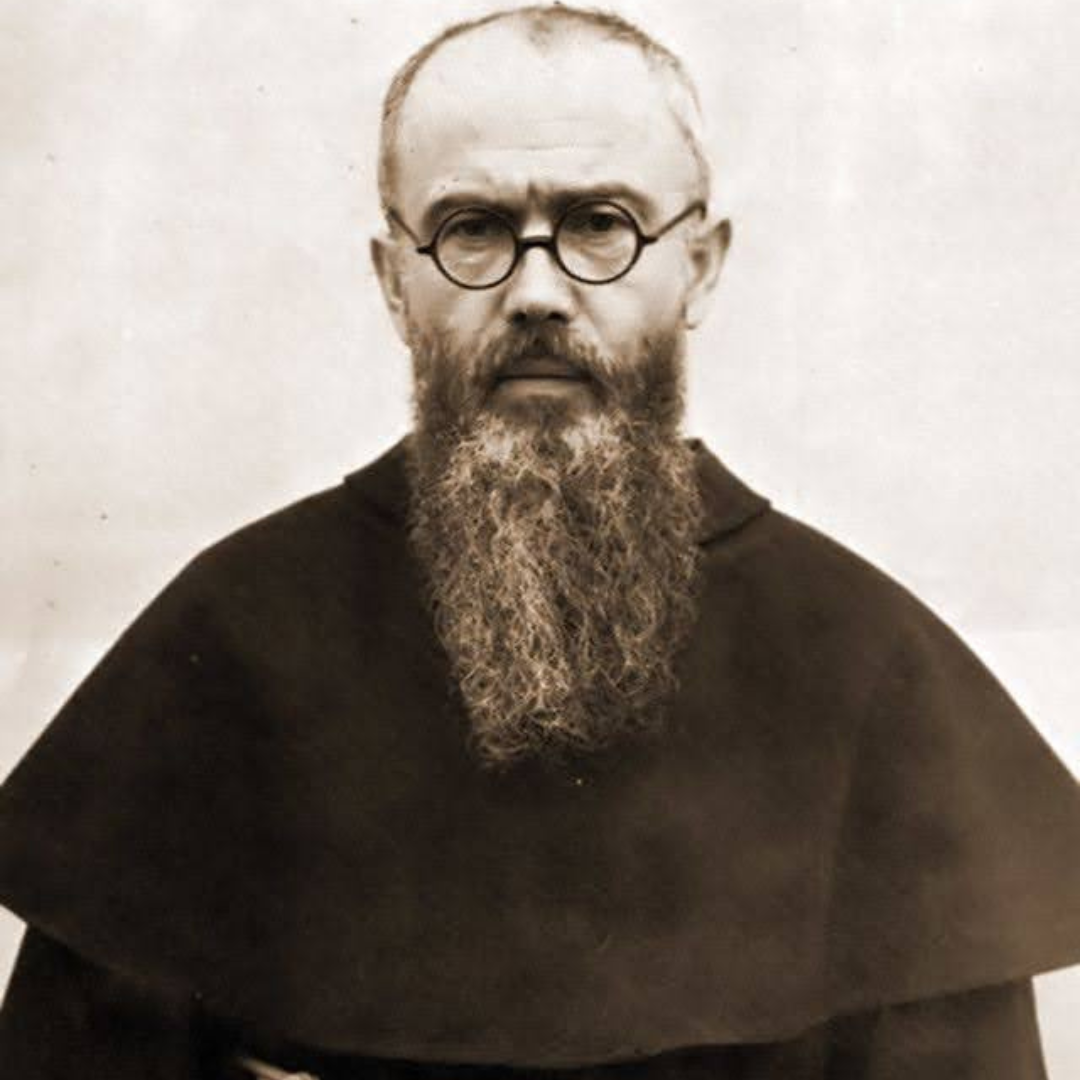

Saint Maximilian Kolbe is most recognizable based on his prominent beard.
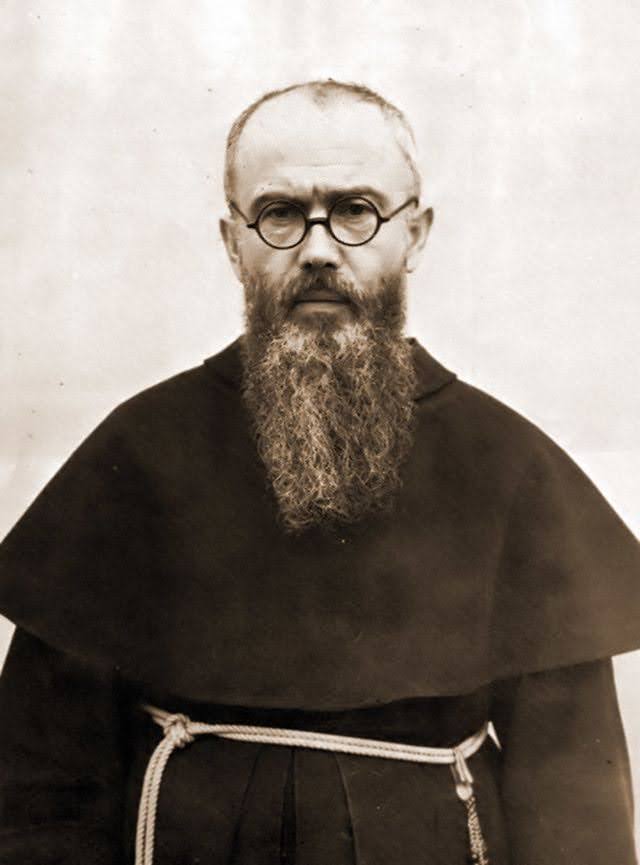
In those days, it was customary for missionaries to keep long beards, and due to his work with the Militia Immaculata, he had earned a prominent spot on Nazi watch lists.
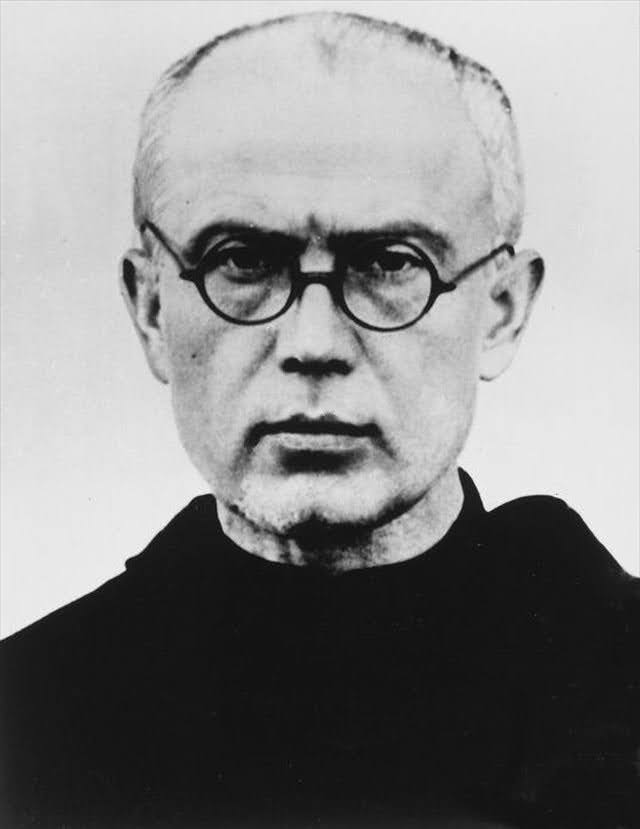
However, during the invasion of Poland in 1939, Kolbe shaved his beard off in hopes of not drawing attention to himself.
This decision would turn out to be a miraculous one, allowing for the veneration of his relics around the world.
This is a photo taken of Saint Maximilian Kolbe without his beard:

According to EWTN,
“On 17 February 1941, he was arrested and sent to the infamous Pawiak prison in Warsaw. Here he was singled out for special ill-treatment. A witness tells us that in March of that year, an SS guard, seeing this man in his habit girdled with a rosary, asked if he believed in Christ. When the priest calmly replied, 'I do', the guard struck him. The S. S. man repeated his question several times and, receiving always the same answer, went on beating him mercilessly.”
In May of that same year, Kolbe was transferred to Auschwitz. There, he was branded with the prisoner number 16670.
Witnesses said that Kolbe provided a place of hope for his fellow prisoners.
At the end of July 1941, a fellow prisoner escaped the camp. This event would change the trajectory of Kolbe’s entire life.
As punishment, a group of men was selected to die by starvation as punishment for the escape. Kolbe offered himself as a replacement for Franciszek Gajowniczek, one of a group of men who were to be killed by starvation. He was a husband and father, and Kolbe was a Catholic priest.
The experience within the starvation cell was extraordinary. According to an eyewitness, the group sang songs, recited the rosary, and slowly passed away until only Kolbe remained.
Kolbe was then injected with carbonic acid and died on August 14, 1941. His body was then burned.
After his death, the story of Saint Maximilian Kolbe’s witness of love in Auschwitz spread quickly. He was beatified on October 17, 1941. The man he gave his life for attended his canonization.
The Story of Saint Maximilian Kolbe's Rare First-Class Relics
Today, Saint Maximilian Kolbe’s recognizable beard is his only surviving first-class relic!
How did this happen?
One would think that, due to Maximilian Kolbe losing his life in an oven at Auschwitz, there wouldn’t be a body available for first-class relics to be made. However, with God, anything is possible!
The only remaining part of Maximilian Kolbe’s body is parts of his distinctively long beard preserved by a fellow friar before the saint's death.
According to the National Catholic Register,
“After a fellow friar cut off Kolbe’s beard for him, the friar at first tried to save the beard, but Kolbe objected and told him to throw it in the stove. So, obediently, the friar threw it into the stove, but the fire was not lit, so the friar later retrieved it and stored it in a pickle jar, where it was later rediscovered and identified thanks to the label the friar had put on the jar.”
A Few Facts About Relics
Relics are the physical remains or personal items of saints or blesseds recognized by the Church. They are used for blessings and intercessory prayers. Think of it as keeping a special keepsake from a deceased loved one–but even better!
Relics of all kinds are often kept in special vessels, in altars, or designated areas within churches, providing an opportunity for the faithful to venerate them.
Sometimes, relics are extra rare or have a special story behind them. Many times, in the case of a martyr’s death, first-class relics may not even exist.
Relics can be divided into first, second, and third-class relics based on a few factors.
First-class relics are the rarest. These are actual body parts of a saint. Oftentimes, it is a small piece of bone, hair, or a bit of blood. First-class relics are considered the most sacred of them all.
Second-class relics include items that the saint personally owned or touched. These are often pieces of clothing, books, or other items.
Third-class relics are objects that have been in contact with a first-class relic. Many times, this would be a holy card or a piece of cloth.