
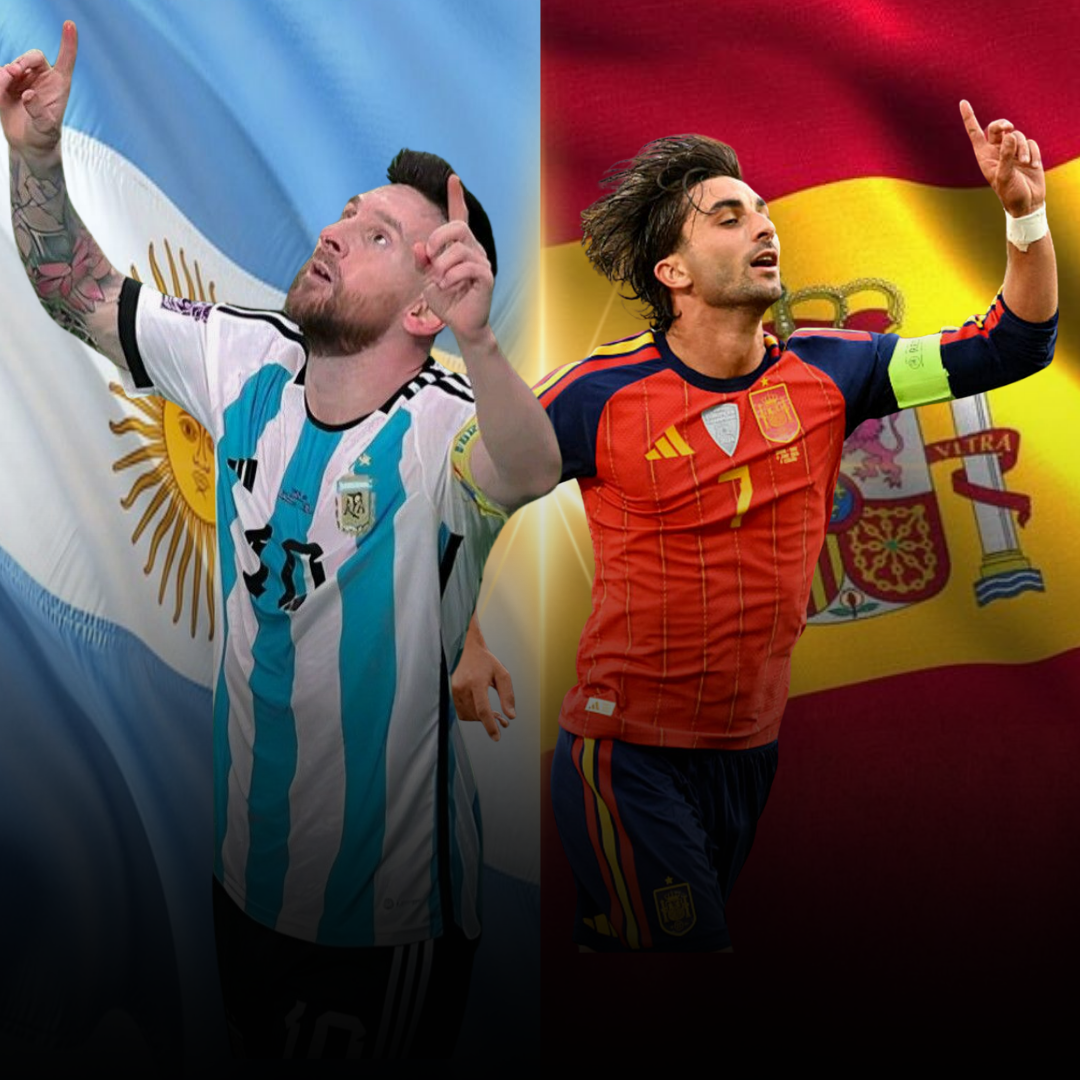
This Sunday, for the second time in history, a World Cup final will be contested between two Spanish-speaking, majority-Catholic countries: one that brought the faith to the Americas, and another that gave the Church the first Pope from the continent.
A “Catholic World Cup”?
From 1930 through the 2022 World Cup, the trophy has largely been “lifted by Catholics.” There is also an added detail: the tournament itself was promoted by a Catholic, Jules Rimet, FIFA president in the 1920s, whose vision gave rise to the World Cup as we know it.
So not only do most champions come from countries with a Catholic tradition, but the very history of the Cup is rooted in the vision of a son of the Church.
Although 23 World Cups have been held, only eight countries have won the title. Of those, six are majority Catholic: Brazil, Italy, Argentina, Uruguay, France, and Spain, while only two are not: Germany and England.
Those six Catholic-majority countries have won 17 of the 22 titles already contested, and the 2026 trophy will go to either Spain or Argentina—two of the most emblematic Catholic nations.
The Faith That Traveled from Spain to Argentina
Five centuries ago, the Catholic faith reached what is now Argentina through Spanish missionaries. The Church founded parishes, schools, and hospitals, and helped shape cities and customs that still define Argentine life.
After gaining independence in 1816, Argentina did not break with that heritage. Its Constitution established that the federal government “supports the Roman Catholic Apostolic faith,” and for decades it required both the president and vice president to be Catholic.
While Spain remained one of Europe’s major Catholic centers, Argentina became a Catholic-majority nation in the Americas—to the point of giving the world, in 2013, the first Latin American Pope: Francis.
Pope Francis was a fan and member of Club Atlético San Lorenzo de Almagro, a popular team founded by Argentine Salesian priest Lorenzo Massa, who died in 1949.
Two Expressions of the Same Faith
Catholicism in Spain is marked by strong traditions of brotherhoods, processions, and an extensive parish network.
Argentina is known for its vibrant popular religiosity, with improvised shrines and deeply emotional connections between faith, national crises, and everyday life.
Spain’s Catholic Figures
In Spain, the faith of some figures is well known. Lamine Yamal—the youngest player to appear in this final—is Muslim, and other players do not publicly profess their faith.
However, national team coach Luis de la Fuente has gone viral during the World Cup not only for his successful campaign, but for openly describing himself as a “practicing Catholic.” He has said that faith gives him “strength and security,” that he prays every day not to win but because he needs it, and that it has helped shape who he is today.
Ferran Torres, a Barcelona forward from a small town in Valencia, has shared that his Catholic faith is always present on the field: he carries a cross and an image of the Virgin. The quiet devotion of this 26-year-old—known for keeping a low personal profile—has been one of the most positive notes of the tournament’s final stage.
Nico Williams has also shown in recent weeks that his sporting career and spiritual life go hand in hand. Kneeling on the pitch and pointing to the sky, he shared a photo on Instagram with the message “God is great,” paired with the song “Yesterday I Spoke with God,” as a clear expression of trust ahead of the final against Argentina. His family story is closely linked to the Catholic Church, as a priest played a key role in helping his parents, originally from Ghana, receive asylum and support upon arriving in Spain.
In one decisive match, Navarrese player Mikel Merino scored the winning goal and, on camera, dedicated it to Saint Fermín, patron of his region, on July 6—the opening day of the San Fermín festival.
And on Argentina’s Side
On the Argentine side, the vast majority of the squad identifies as Catholic, with some describing themselves as Christian. Around 75% of players have tattoos expressing their faith: images of Christ, the Virgin Mary, rosaries, and crosses are among the most common.
In their locker room, the team keeps an altar with various devotions, always centered on an image of Our Lady of Luján, the country’s patroness, who—according to multiple reports—has accompanied the team for about 40 years.
Coach Lionel Scaloni is known to attend Mass with his family. A priest close to the team, Juan José Medina, described him after the Qatar World Cup—where Argentina lifted the trophy after defeating France—as a serious man who deeply feels his responsibility and lives it not only through soccer but also through culture.
Lionel Messi, the team’s undisputed star, is Catholic. He celebrates goals by dedicating them to God and frequently thanks the Lord for the gift of playing soccer and for the blessings he has received. One of his most iconic tattoos is an image of Jesus Christ on his right arm.
"YA NO PODEMOS PEDIR MÁS"
— DSPORTS (@DSports) July 15, 2026
Lionel Andrés Messi, tras avanzar a una nueva final. @nanisenra#MundialEnDSPORTS #FIFAWorldCup pic.twitter.com/TAHqoBmWxm
According to various reports, other players known for their Catholic faith include Alexis Mac Allister; Lautaro Martínez—who keeps images of Our Lady of Luján inside his shin guards; Cristian “Cuti” Romero; and Lisandro Martínez. The latter two went viral for using holy water and praying before entering the field in key matches.
Argentina’s Locker Room Altar
One of the most viral images of this World Cup is the altar set up in Argentina’s locker room before each match. Alongside the prominent image of Our Lady of Luján are also images of Mary Undoer of Knots—one of Pope Francis’ most beloved devotions—and a statue of Saint Expeditus, one of the most popular saints in the country and the patron of urgent causes.
As an anecdote, the church of Balvanera in Buenos Aires—where Saint Expeditus is especially venerated—was filled with Argentine flags and the faithful after Argentina’s victory in the 2022 World Cup final.
It is also known that at the headquarters of the Argentine Football Association (AFA), where the national team trains and stays, there is a chapel dedicated to Saint Francis of Assisi, where Masses are offered and even funerals for soccer figures are held.
In this World Cup final, Spain and Argentina will compete for a trophy, but the match will also be the culmination of a tournament in which faith has played a visible role—even amid restrictions on religious expression on the field. Who wouldn’t want to see this celebration repeated in 2030?