

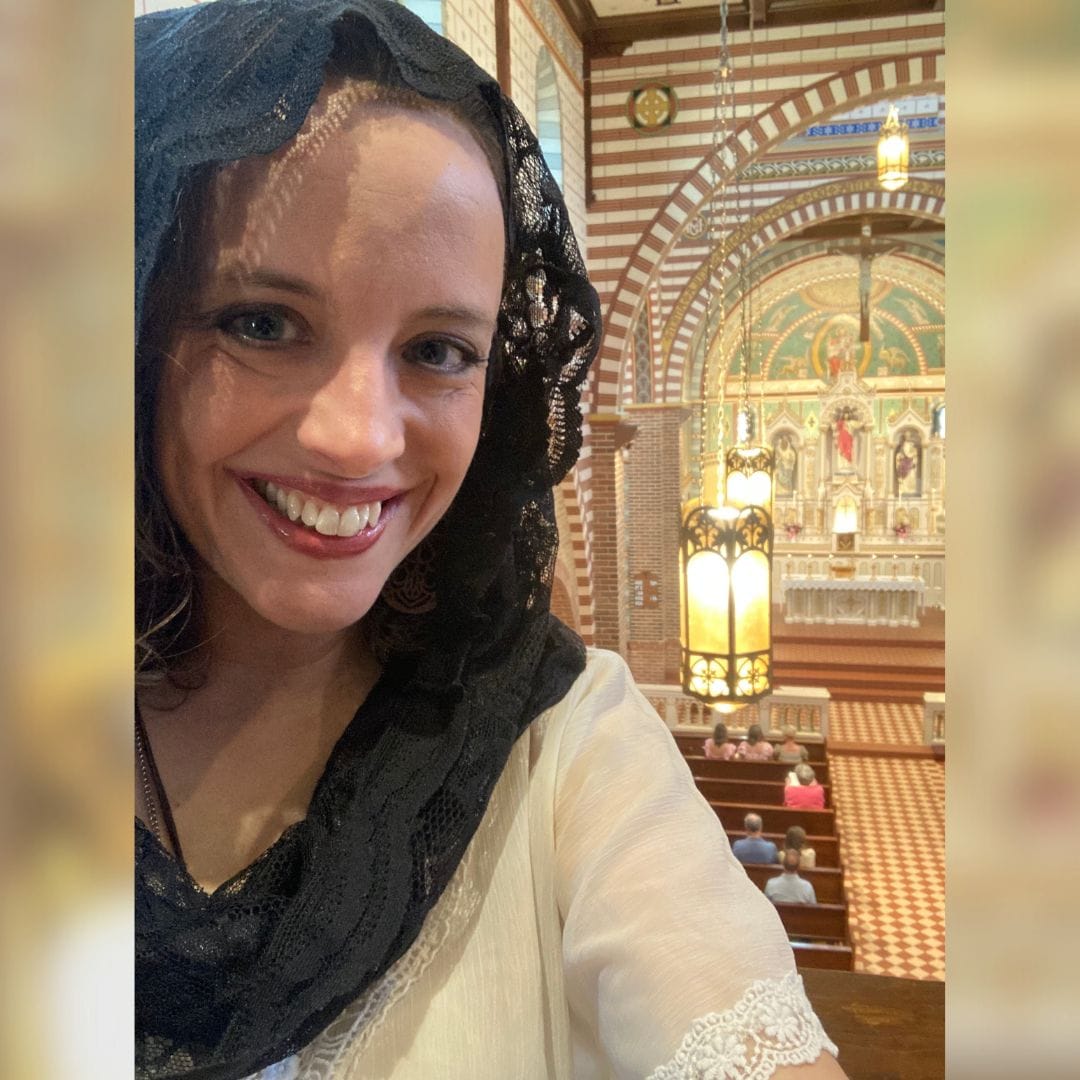
There’s no doubt about it: veiling in church is making a comeback!
While chapel veiling is no longer required by the Church, many women, both young and old, are opting to do so throughout the Catholic community.
With its roots in Biblical tradition, the custom of veiling is a long-standing and beautiful piece of our Catholic tradition, and while there is an immeasurably rich background behind this tradition, here are just three great reasons to don your own mantilla:
1) Veiling is a physical reminder that you are entering a Sacred space.
From the great basilicas and cathedrals around the world to your own neighborhood chapel, every Catholic church is the home of God, and every Mass is His Sacrifice. Because of this, we make a point to dress well for Mass as a sign of respect for the house of the Lord and the sacrament we are attending.
However, the chapel veil extends this practice to that of a devotion.
While there are a multitude of reasons for getting dressed up, the mantilla is reserved for church and for church alone. It becomes a consistent reminder of the dignity of the place, a preparation for Mass which is singular and sacred.
Just as the beauty of the church-building is in itself a visual hymn to the glory of God, we do not dress well for our own glory but as a physical form of devotion and worship.
Thus, the chapel veil marks these preparations as sacred: we are not merely getting “dressed up”; we are preparing to worship.
I had the privilege to spend my last semester of college abroad with Franciscan University’s Austrian program. While traveling, I made a point to carry my chapel veil with me and to wear it, or some other hat or covering, whenever I entered a church.
While the constant on-and-off became a hassle (especially during the walking tours in Rome), that very hassle helped mark the difference for me between entering a church and any other tourist site, and was a consistent reminder that every church, basilica, and cathedral was sacred and housed the Eucharist.
While, yes, I was there to “sight-see”, I was more importantly there as a pilgrim.
2) Veiling is a sign of feminine dignity.
One of the most frustrating misconceptions regarding the practice of veiling is the idea that the veil represents the masculine dominance in the Church, that it exists to “put down” women and remind them of their place. Certainly, the practice does remind women of our place, and it is not at all a humiliating one!
The veil marks the woman as consecrated, not in the formal sense of a religious vow but in the universal sense that every woman is sacred. Indeed, within the Church’s tradition, we veil what is sacred, from the tabernacle which houses Our Lord to the altar on which He is sacrificed.
A woman is marked by her mantilla as belonging to God. We are veiled because we belong, not to a pretentious patriarchal hierarchy, but to God.
This concept of the veiled sacred is uniquely linked to women’s special dignity and role: one reason we dress modestly is to protect the beauty of the human form from becoming profane, and more fundamentally, to femininity, the woman is herself a veil over her life-giving womb.
Thus, the chapel veil is both literal and symbolic, a veiling not only of the sacred but also over the sacred.
3) Veiling is half of a beautiful dual tradition.
The veil is also a sign of humility and devotion. Meant to cover a woman’s hair (which is traditionally considered her crowning beauty), the mantilla becomes a symbol of humility and devotion.
We are all familiar with the reverence due within a church; we lower our voices, for example, to facilitate the atmosphere of prayer. The veil is meant to represent this same reverence visually.
However, while the special act of veiling is for women alone, this reverence ought to be practiced by all. Hence, the tradition of the chapel veil is mirrored by the male’s duty to remove his hat within a church. Indeed, it used to be the tradition for a man to doff his cap when even passing by a church as a sign of devotion to the Eucharistic Christ within (just like they would in greeting a woman).
Thus, the veil participates in a dual tradition of men and women uncovering and covering their heads, respectively, when entering a church.
Indeed, this very tradition mirrors the general nature of spirituality for men and women. While all of humanity is called to the same standard of holiness and ultimate Beatitude, men and women have different paths and vocations.
Thus, just like men and women pursue different, or even opposite, vocations to obtain the same holiness, they follow mirror-image traditions in expressing the same reverence for the house of the Lord.
(Side note: I am also a proponent of hats for men, so we can all participate in this tradition!)
Bonus: Veils are also simply beautiful!
So, add some pious pizzazz to your Sunday attire, and get your mantilla today!