

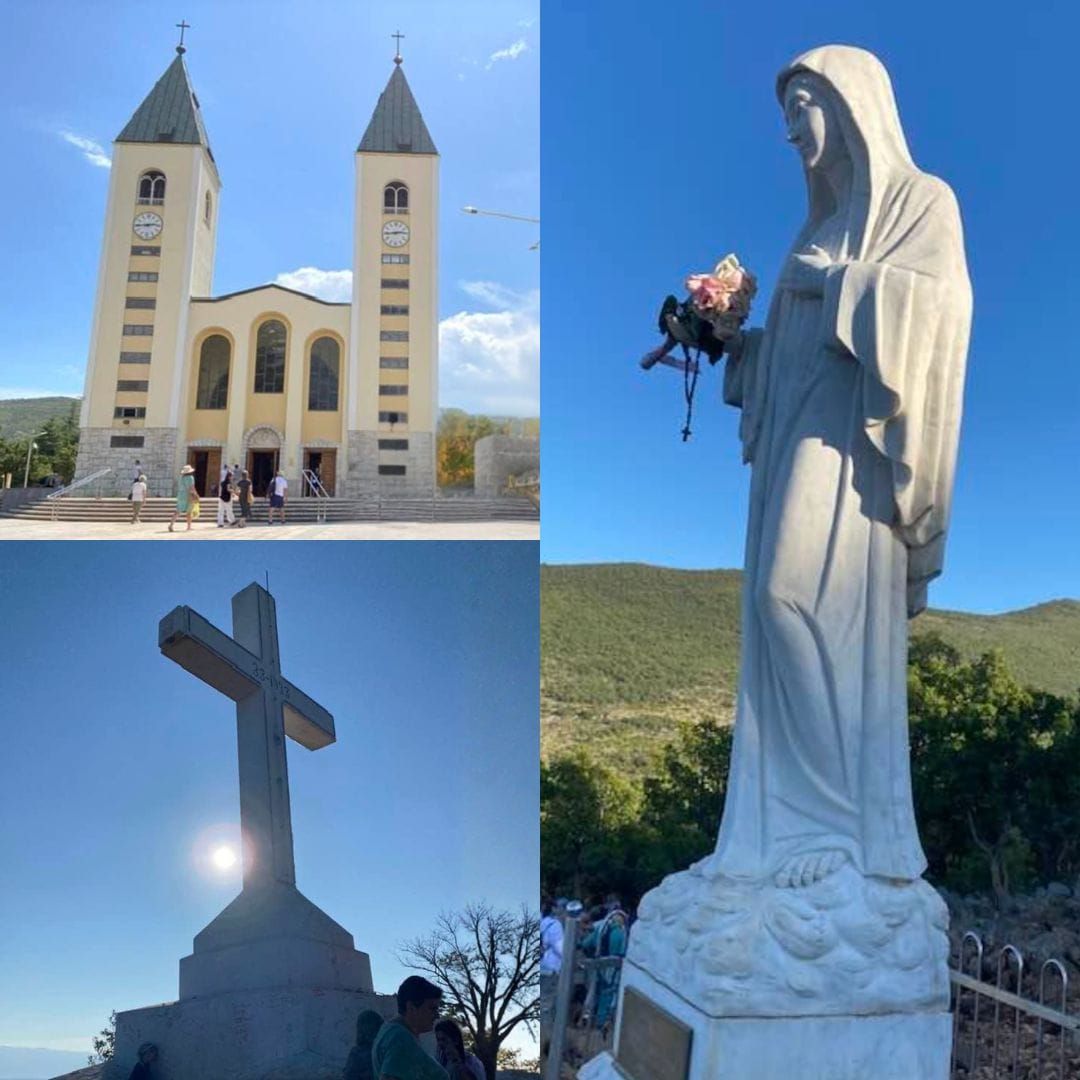
Before dawn, the world woke up to heartbreaking images from Medjugorje: statues of Our Lady defaced with black paint and blasphemous graffiti, and the outdoor altar of St. James Church set on fire just days before the annual youth festival. Local authorities say multiple Marian shrines were targeted in a coordinated attack, including Apparition Hill (Podbrdo) and areas near the Blue Cross, leaving many pilgrims shocked and deeply hurt.
Yet in the face of this violence, the parish of Medjugorje and many Catholics around the world are returning to the very heart of its message: prayer, fasting, conversion, and forgiveness. Priests connected with Medjugorje often summarize this spirituality into five simple but powerful practices—popularly called the “five stones,” recalling David’s battle against Goliath. Just as David chose five smooth stones to face a giant, many believers see these five spiritual “weapons” as God’s way of equipping them for the giants of our time.
These “five stones” are:
- Daily prayer, especially the Rosary
- Fasting, typically on Wednesdays and Fridays
- Daily reading of Sacred Scripture
- Monthly confession
- Frequent participation in the Eucharist
Far from being something “new,” these are classic, deeply Catholic practices—yet countless pilgrims say they rediscover them in a fresh way at Medjugorje, especially through long confession lines and intense Eucharistic devotion. Many testify that when they begin to live these five stones seriously, their faith comes alive: prayer deepens, love for the Mass grows, and real conversion of heart begins.
Now, after the recent acts of desecration, these humble “stones” take on an even more concrete meaning. The parish has explicitly called the faithful not to respond with hatred, but with “prayer, fasting, and forgiveness,” turning spiritual weapons against evil rather than people. In a world overwhelmed by noise, anger, and spiritual confusion, the five stones of Medjugorje stand out as a simple, concrete path back to God—and a powerful way to pray for peace, reparation, and healing for this wounded shrine.
What is Medjugorje?
Since June 1981, six children in the village of Medjugorje, in present-day Bosnia-Herzegovina, claimed to see and receive messages from the Blessed Virgin Mary.
More than 40 million pilgrims have since traveled to the small village, with an estimated 1 million visiting annually. Many describe the experience as deeply personal and transformative, especially when climbing the rocky Apparition Hill (Podbrdo) or praying the Stations of the Cross up Mount Križevac (Cross Mountain), where a towering cross overlooks the region.
At the heart of the pilgrimage is St. James Church, where Masses are celebrated daily and confession is constantly available—something Medjugorje has become especially known for.
The six visionaries—now adults—are: Marija Pavlovic-Lunetti, Ivan Dragicevic, Vicka Ivankovic-Mijatovic, Jakov Colo, Mirjana Dragicevic-Soldo and Ivanka Ivankovic-Elez.
Some of them say they still receive apparitions today, while others report annual or monthly encounters.
As reported by EWTN Vatican, in September 2024, the Vatican has officially granted the “nihil obstat” (nothing stands in the way) to the devotion and spiritual experience in Medjugorje. This marked a significant moment for the millions of faithful who have followed the alleged apparitions of the Blessed Virgin Mary.
The Vatican’s decision came after decades of in-depth investigations, inquiries, and studies, but included no decision regarding the authenticity of any of the claimed events.