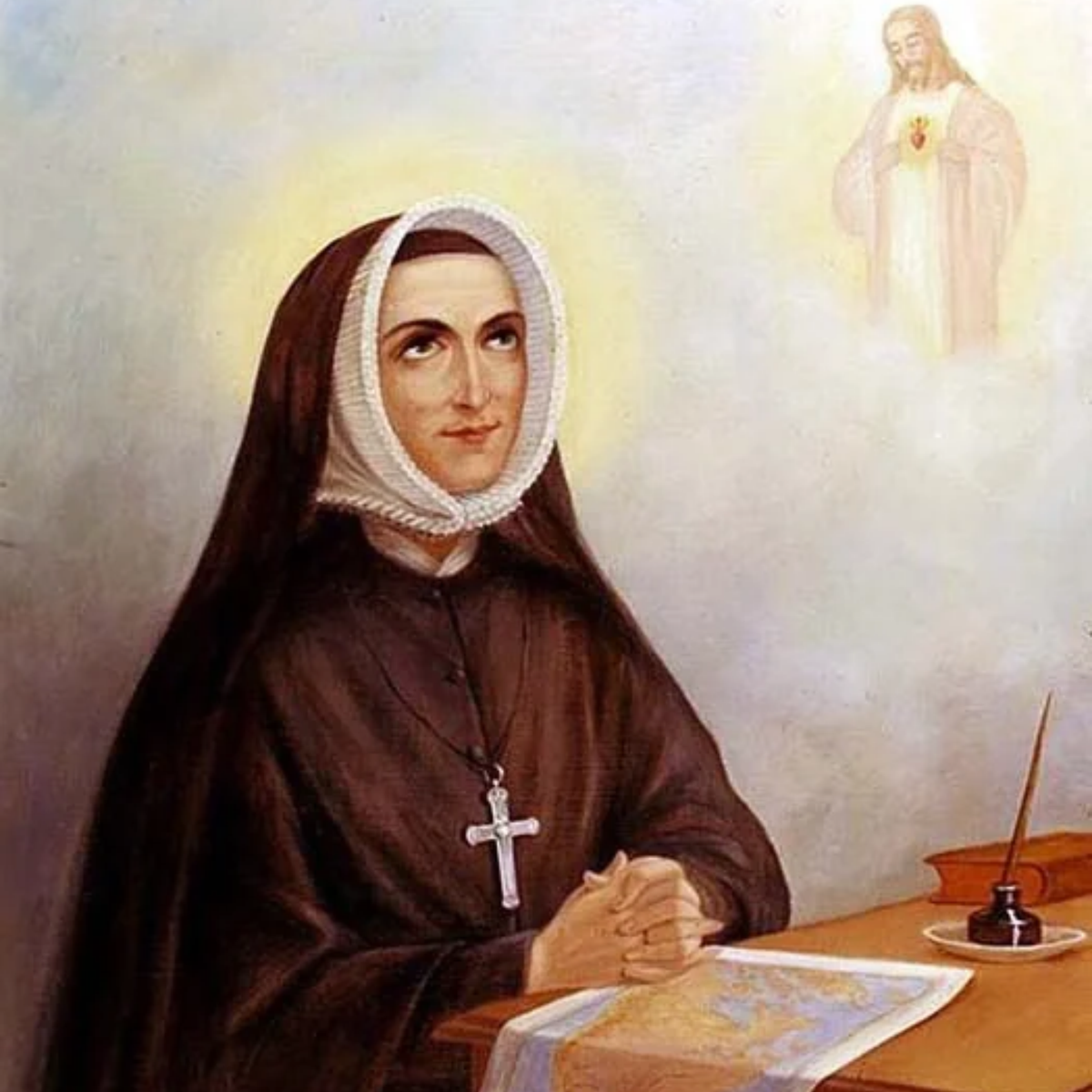
Before St. Rose Philippine Duchesne became one of America’s pioneer saints (celebrated each year on November 18), she was a wealthy French teenager who literally snuck out of her own family’s home to become a nun.
A woman tough as nails who survived the French Revolution, she crossed the Atlantic at nearly 50, and built schools across the rugged American frontier.St. Rose proved that holiness isn’t about slowing down — or even staying in charge. Here are five fascinating things to know about this 19th-century French dynamo:
1. She Outsmarted Her Parents to Enter the Convent
Born into a wealthy, politically prominent family in Grenoble, France, in 1769, Rose Philippine was expected to be the bride in a prestigious marriage. Instead, at age 18, she enlisted the help of a sympathetic aunt to sneak away to a local Visitation convent — and flat-out refused to leave when her furious father arrived to bring her home. Even after the French Revolution forced her convent to shut down and scatter the nuns, she refused to hide away: she stayed in the city, opened a school for homeless children, cared for the sick, and risked her neck aiding underground Catholic priests.
2. She Waited Over a Decade — and Crossed the Ocean at Age 48 — for Her Dream Mission
After joining the newly founded Society of the Sacred Heart in 1804, Rose Philippine burned with a desire to serve as a missionary in the Americas. Her superiors kept saying “not yet” — for 14 years. When she finally got the green light in 1818, she was already 48 years old. Undeterred, she sailed across the Atlantic with four sister nuns on a dangerous 10-week voyage to Louisiana, eventually pushing up the Mississippi River to the frontier outpost of St. Charles, Missouri.
3. She Opened the First Free School West of the Mississippi
When St. Rose arrived in Missouri, she found log cabins, freezing winters, and zero formal education for girls. Within months, she opened a log-cabin school in St. Charles — the very first free school for girls west of the Mississippi River. Over the next two decades, despite battling malaria, freezing temperatures, and chronic shortages of food and money, she founded half a dozen schools and convents across Missouri and Louisiana, educating both settler children and Native American youth.
4. She Was Terrible at Learning Languages — and Kept Going Anyway
In 1841, at age 72, the Jesuits invited the Sacred Heart sisters to establish a mission for the Potawatomi tribe in Sugar Creek, Kansas. St. Rose insisted on going, even though her health was failing and she could never master English — let alone the Potawatomi language. Unable to teach, preach, or run the mission as she had in Missouri, she embraced a hidden apostolate: praying constantly for the tribe and her fellow sisters while sitting quietly in the chapel.
5. Mischievous Kids Tested Her Focus — and Gave Her an Unforgettable Nickname
The Potawatomi children were so captivated by the elderly French nun who knelt motionless in prayer for hours that they affectionately named her Quah-kah-ka-num-ad — ‘Woman Who Prays Always.’ According to mission accounts, a few playful kids decided to test just how still she really was by tossing tiny scraps of paper onto her habit while she prayed — only to come back hours later and find every single scrap sitting in the exact same spot.
Canonized by Pope St. John Paul II in 1988, St. Rose Philippine Duchesne remains a patron saint for anyone who feels sidelined by age, illness, or circumstances — proving that when we can no longer run the show, our quiet fidelity can still move mountains.