
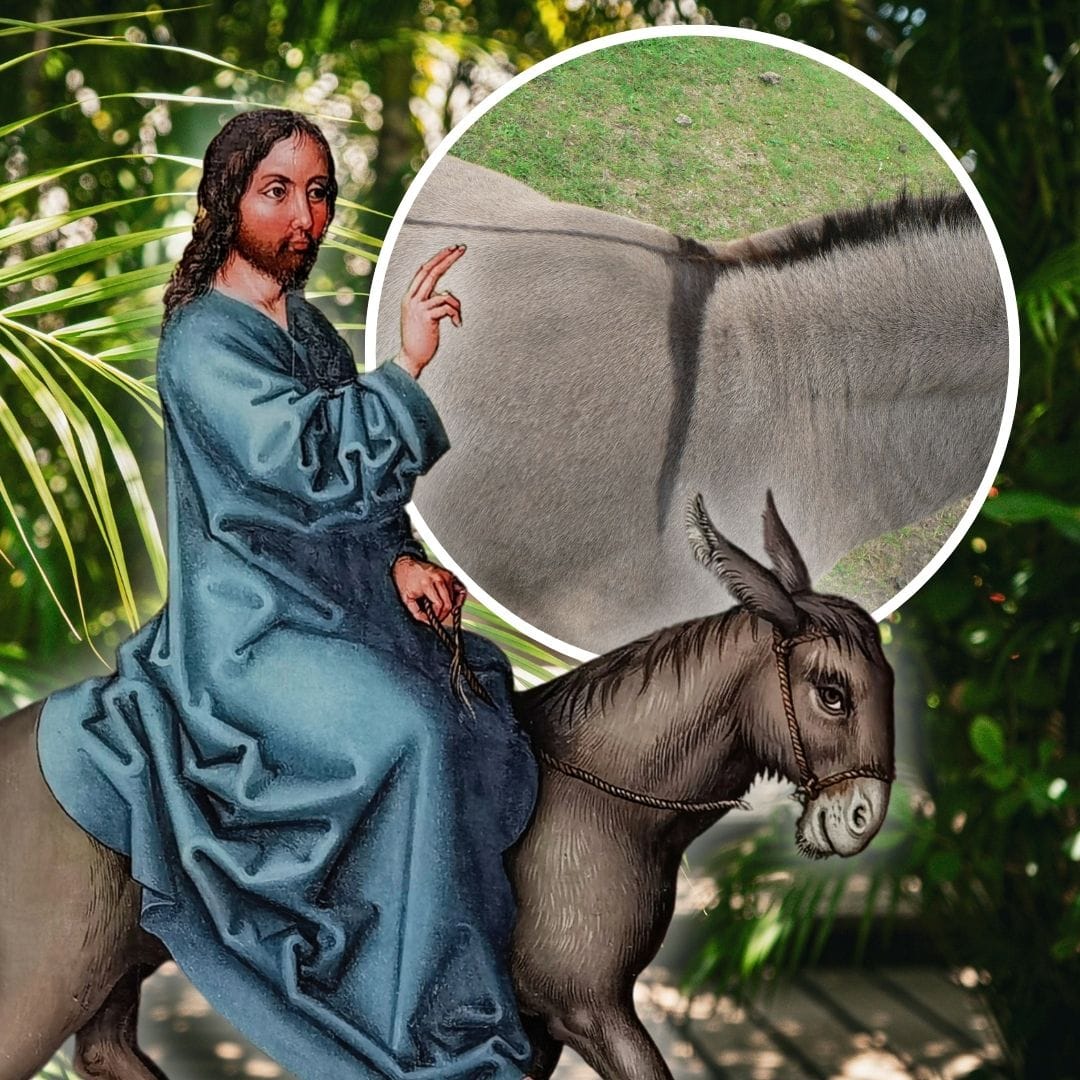


If you’ve ever looked closely at a donkey, you’ll notice something amazing: they usually have dark markings that form the shape of a cross along their back and shoulders.
That little cross is like a quiet spoiler from God about the donkey’s mission—this humble animal was made to carry burdens, to carry Jesus, and to point straight to the Cross and our hope.
In Catholic art, parish plays, and processions, the donkey shows up in two big moments: beside baby Jesus in the Nativity scene and carrying Jesus on Palm Sunday as He enters Jerusalem.
Was there really a donkey in Bethlehem?
In his book, Jesus of Nazareth: The Infancy Narratives, Benedict XVI points out something many people overlook: the infancy Gospels do not speak of an ox or a donkey in the stable. He stresses that, in a strictly historical sense, “there is no mention of animals” at the place where Jesus was born.
However, he immediately adds that Christian iconography “filled this gap”: if the Child is laid in a manger, the place where animals eat, tradition very quickly pictured the ox and the donkey beside Him, and no Christian representation wants to give up this image. He does not “expel” the donkey from the crib, but shows how the Church’s faith has read that detail spiritually.
In the background lies the patristic reading of Isaiah 1:3:
“The ox knows its owner, and the donkey its master’s crib; but Israel does not know, my people do not understand.”
The early Church Fathers saw in the ox and the donkey at the crib an image of the people of Israel and of the Gentiles, called to recognize Christ in the humility of the Incarnation.
Historically, we can’t prove a donkey stood there. Spiritually, the donkey becomes a sign of hope for all of us who feel small or weak.
The Palm Sunday donkey: the one we’re sure about
This time, there is no doubt at all: there is a donkey, and he is essential to the story. Jesus tells His disciples to find a young donkey for Him to ride into Jerusalem. That’s not random transport; it’s a deliberate sign. He is fulfilling an Old Testament prophecy that says the King will come “humble and riding on a donkey.”
In a Palm Sunday homily from 2006, Pope Benedict XVI commented on the symbolism of the signs of that day: the palm branches as a sign of martyrdom, the olive branches as a sign of messianic peace, and the figure of Jesus entering Jerusalem as the King of peace.
He does not enter on a warhorse, but on a beast of burden, a sign of meekness and humility; in this way, He reveals the true style of His kingship.
According to him, the choice of the donkey shows a twofold dimension: on the one hand, the fulfillment of God’s promises; on the other, the renunciation of the models of power and violence that the world expects from a king.
The Messiah enters His city not to conquer it by force, but to hand Himself over: the very crowds who cry “Hosanna,” acclaiming the humble King, will, a few days later, demand His crucifixion.