
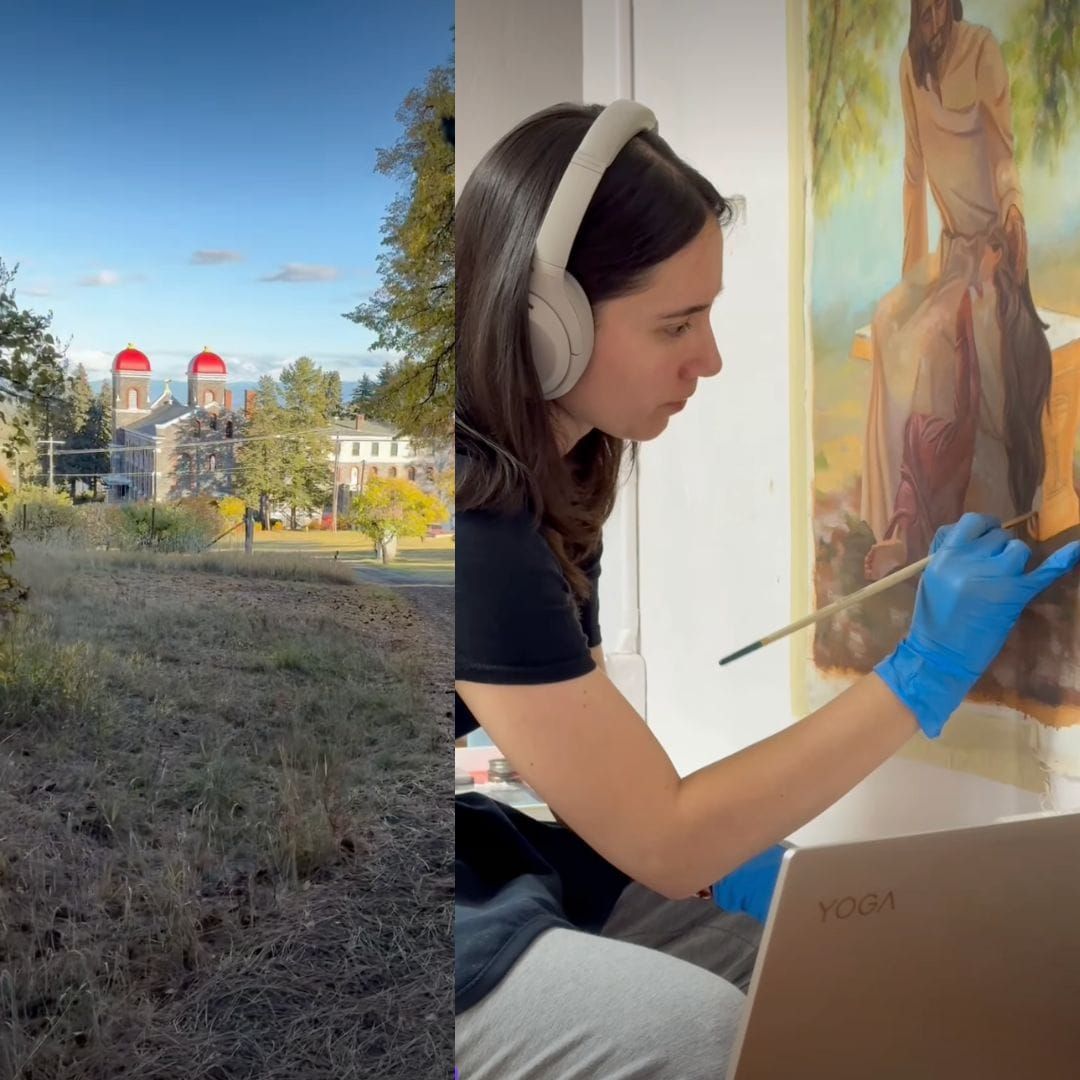
For Catholic artist Kelly Luong, a month-long residency at St. Gertrude’s Monastery became much more than dedicated studio time. Immersed in the Benedictine rhythm of Mass, prayer, silence, work, meals, and community, she said God taught her to rest, create freely, and see her vulnerable artwork as a way of loving others.
St. Gertrude’s Artist in Residence program gives women visual artists, musicians, and writers the opportunity to live at the Monastery of St. Gertrude in Cottonwood, Idaho, for a month, with studio space and participation in community life.
“I was raised Catholic, and my art and my faith are heavily intertwined,” Luong told ChurchPOP.
Luong said the residency began with a prayer during a difficult period in her life.
“One afternoon, I was praying on the verse about how new wine needs new wine skins otherwise it would burst,” she said. “I felt like I was bursting at the time, that I wasn’t molding and growing with God’s grace, but I was breaking and failing.”
She brought that pain directly to God.
“So I asked God, how do I become a new wine skin? It was that night I had the thought to look into artist in residence programs that were also Catholic and I found St. Gertrude’s Monastery.”
For Luong, discovering the monastery’s residency program felt providential, an opportunity to let God reshape her life and creativity.
“As I explored the program and the monastery’s website I knew, if I could go, I could learn to be a new wine skin,” she said.
Still, she struggled with hesitation, wondering whether she and her art were “good enough,” and whether she could make the time away from her ordinary responsibilities. “But my longing outweighed my fear and I applied,” said the artist.
A Freedom Found in Structure
At the monastery, Luong joined the Benedictine sisters for Mass and for morning, afternoon, and evening prayer. Rather than distracting from her creative process, the prayerful structure gave her a healthier, freer way to approach her work.
“My days were molded around prayer times, and it was exactly what I was asking God to teach me,” Luong said. “Time was perfectly balanced. I learned no task was more important than another. There was time for prayer, time for work, and time for leisure.”
She said this was a significant change from her tendency to become intensely focused and overwork herself.
“I have a tendency to be hyper focused, and work my body and mind into the ground,” she explained. “It might seem like a paradox, but the structured day created more freedom.”
The monastery freed her from the pressure to maximize productivity and finish as much as possible. Instead, she entered her studio with openness to what God might want to reveal.
“I released myself from the pressure of being hyperproductive and following a strict schedule to complete the most amount of work,” she said. “I had a general plan and ideas for paintings going into it, but when I got there it almost all went out the window.”
Art as Prayer and an Invitation
During the residency, conversations with another artist helped Luong understand that God speaks to people personally and creatively.
“The first realization came from talking with my fellow artist in residence, she is a musician and interacts similarly but through music,” Luong said. “In our conversation, I realized what a gift it is for God to speak to us in the unique ways each of us would understand him.”
She also encountered people who wanted to visualize their prayer but felt held back because they did not consider themselves artists.
“In other conversations, I heard how others desired to learn how to visualize and create images through prayer but what stopped them was the belief they couldn’t draw,” she said.
As an art instructor, Luong wanted to offer a different perspective: prayer does not require artistic perfection.
“I’m an art instructor and I firmly believe anyone can learn how to create, and if you take a step back, people can learn how to visualize,” she said. “A simple doodle can be a reminder of your conversation with God, it doesn’t have to make sense to anybody but you.”
The residency also changed the way she understood sharing her own highly personal work. Luong kept her studio door open—not only because of oil-paint fumes, but to welcome the sisters, visitors, and fellow residents into her creative process.
“Through many conversations with sisters, community members, visitors, and my fellow artist in residence; I realized my vulnerability was something God could use to love others,” she said.
“My art may be my way to personally understand God’s love for me more intimately, but it’s also an instrument that He continues to use to reach other’s hearts too.”
Four Paintings of Christ’s Comfort
During the month, Luong created four 20-by-28-inch oil paintings: one standalone work and a three-painting series inspired by Christ’s relationship to water, suffering, redemption, and hope.
Her first painting portrays a vulnerable, barefoot woman in worn and frayed clothing sitting at Jesus’ feet and resting her head at His side. Christ gently strokes her hair as they sit together in silence.
“While the woman’s burdens aren’t taken away, she is given immense comfort and peace,” Luong said.
The image came during a silent retreat with the Sisters of Notre Dame shortly before her monastery residency. Luong had asked God what He wanted her to do, and she encountered this image in prayer. “I hope others who are weary can look at the image and also receive God’s steady love, and reliable comfort,” she said.
Her three-painting series developed from praying the Luminous Mysteries of the Rosary. While she initially expected to paint every mystery, Jesus’ Baptism struck her in a new way and revealed a unifying theme: Christ entering humanity’s darkness and redeeming it.
The first painting depicts Christ’s Baptism, with water that is “twisted and heavy.”
“Yet Jesus entered into it,” Luong said. “He entered into our sin in order to save us. And we also have to work through our sin, and what awaits us is the heavens.”
Her hope is that viewers see not only the reality of sin and struggle, but the promise beyond them: “In this painting, I want people to feel hope that the heavens are waiting for them.”
The second work draws on the Gospel account of Jesus walking on water and calling Peter to come to Him. Luong connected the scene to seasons when she longs for quiet prayer but finds her mind raging “like a storm.”
“He knows it’s taking everything in us to take a single step towards him, and he is shouting, cheering, and calling us closer,” she said.
She portrayed Christ with His arms outstretched as a reminder that He understands how difficult it can be to trust Him amid interior turmoil.
“In this painting, I hope people can feel Christ as their anchor in a storm and grant them peace.”
The final painting is inspired by Jesus telling Peter to cast his nets into the deep after a fruitless night of fishing. For Luong, it became an image of persevering in faith when suffering, failure, or confusion make God’s promises difficult to see.
“This last painting was a leap of faith for me, it was a promise of abundance that comes from giving your turmoil and suffering to God,” she said.
For Luong, the month at St. Gertrude’s did not simply produce a body of paintings. It gave her a life lesson in Benedictine balance: prayer before productivity, openness before control, and the confidence that God can use even a person’s vulnerability to bring comfort and hope to someone else.