

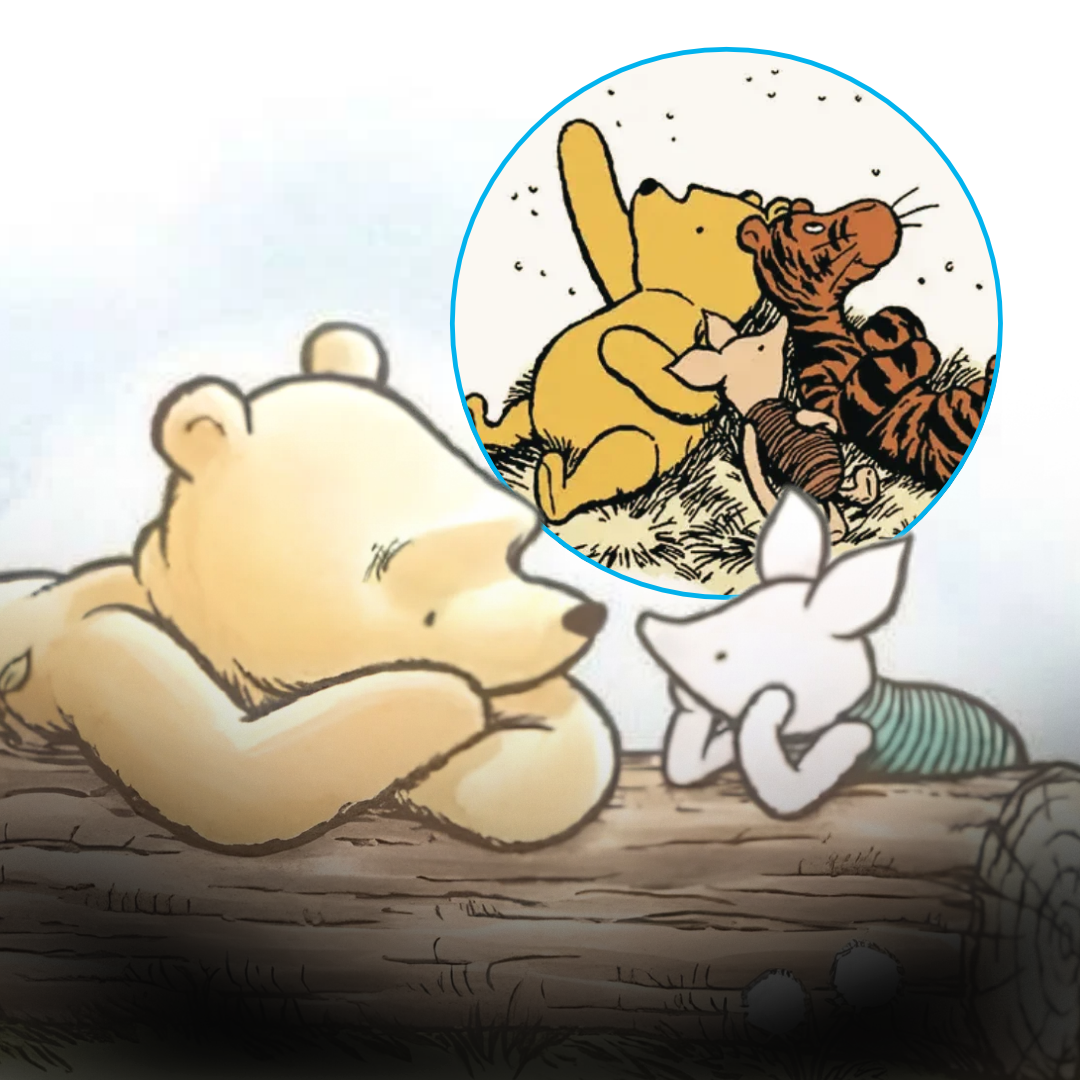
It was 100 years ago today — on Oct. 14, 1926 — that author A.A. Milne first introduced the world to Winnie the Pooh, his many friends, and the world within the Hundred Acre Wood.
As a young girl, I spent countless hours watching Winnie the Pooh and humming “Little Black Rain Cloud” around my home. Now, as a mother to a toddler, I have found myself reliving these stories through the eyes of my own child, who also spends her evenings watching Winnie the Pooh and singing the theme song repeatedly as we drive in the car.
While I was rewatching these movies and episodes, I couldn’t help but notice that several Christian themes arose in the content. And while these stories were not written with a Christian perspective, there are Christian truths that we can see reflected.
Here are 5 Christian themes seen in Winnie the Pooh:
1. Loving your neighbor and seeing the good in others
The Hundred Acre Wood is filled with characters who are very different — from the anxious Piglet to the controlling Rabbit and know-it-all Owl — yet, despite their differences, these characters form a community. They spend time together, help each other through difficulties, and continue to include one another even when their personalities clash.
Jesus' command to love our neighbor isn't dependent on having the same personality, interests, or opinions. Christian love challenges us to recognize the dignity of every person, even those who might frustrate or confuse us.
It's easy to love people who make us comfortable. It's harder when someone has a completely different temperament, worldview, or way of doing things. Yet those differences don't make a person any less worthy of our patience, kindness, or respect.
The Hundred Acre Wood reminds us that a community becomes richer when its members don't all have to be the same. For Christians, this is a reminder that we're called to build relationships with people beyond our immediate circles of similarity. We don't have to agree on everything to treat one another with charity.
2. Sacrificial love
Pooh is famously willing to go to extraordinary lengths for his friends — even when it's inconvenient, uncomfortable, or downright ridiculous. He doesn't always have the best plan, and his attempts to help can sometimes lead to unexpected complications, but his intentions are rooted in affection for those he loves.
Pooh's willingness to help his friends offers a simple reminder that love isn't merely a feeling. Love becomes visible through the things we're willing to do for others.
This is at the heart of the Christian understanding of love. In John 15:13, Jesus tells his disciples, “Greater love has no man than this, that a man lay down his life for his friends.” Jesus ultimately demonstrates this perfect, self-giving love through His sacrifice on the Cross.
While Pooh's little adventures are obviously not comparable to Christ's sacrifice, they can still remind us of the everyday ways we're called to love others selflessly.
Sacrificial love doesn't always require dramatic gestures. Sometimes, it means setting aside our own plans to help a friend, listening when we'd rather be doing something else, or patiently caring for a family member when we're tired.
3. Caring for the vulnerable
Eeyore is the gloomy, pessimistic, and often overlooked resident of the Hundred Acre Wood. However, his friends don’t write him off. They continue to include him and remind him that he matters.
Throughout the Gospels, Jesus repeatedly notices people who are suffering, excluded, or overlooked by others. He stops for those in need, welcomes those whom society pushes aside, and reminds us that every person has dignity.
In our own lives, the people who need our compassion might not always look like Eeyore. They might be the friend who is always struggling, the coworker who seems withdrawn, the family member who is going through a difficult season, or the person at church who always sits alone.
Sometimes, a simple invitation, a thoughtful message, or the willingness to sit with someone in their sadness can make a real difference.
4. Childlike wonder
The Hundred Acre Wood is filled with imagination, wonder, and an appreciation for little things. Pooh doesn't need grand adventures or extraordinary experiences to be happy. A walk through the Hundred Acre Wood, a pot of honey, or a conversation with Piglet can be enough to make an ordinary day special.
In Matthew 18:3, Jesus tells his disciples, “Unless you turn and become like children, you will not enter the kingdom of heaven.”
Jesus isn't asking us to be immature or naive. Rather, childlike faith invites us to approach God with trust, humility, openness, and wonder. Children are often willing to marvel at things adults have learned to overlook. They ask questions, delight in small discoveries, and depend on others without feeling the need to have everything figured out.
As adults, it's easy to lose that sense of wonder. We get caught up in our responsibilities, our worries, and the constant pressure to accomplish more.
Pooh offers a gentle reminder to slow down and notice the goodness in the ordinary and that maybe sometimes, growing in faith means learning to see the world with the wonder we had as children.
5. Humility
Pooh isn't particularly concerned with appearing impressive. He's simply Pooh — a bear who loves honey, enjoys his friends, and finds himself in little adventures. There's something wonderfully innocent about Pooh's willingness to simply be Pooh, which in turns reflects his humility.
Humility doesn't mean thinking we're worthless or pretending we have no gifts. Rather, it means recognizing the truth about ourselves: our strengths and weaknesses, our dependence on God, and the fact that we don't need to be the center of attention.
This reminds me of St. Thérèse of Lisieux and her “Little Way,” who reminds us that we don't have to do extraordinary things to become holy. We can become saints through the little things, when we do them with great love.
Of course, Pooh isn't intentionally practicing Catholic spirituality, and his character shouldn't be confused with a model of Christian holiness in every respect. But his unassuming nature can remind us of a truth that St. Thérèse understood so well — holiness isn't reserved for people who do extraordinary things. It's possible in the ordinary moments of every day.