

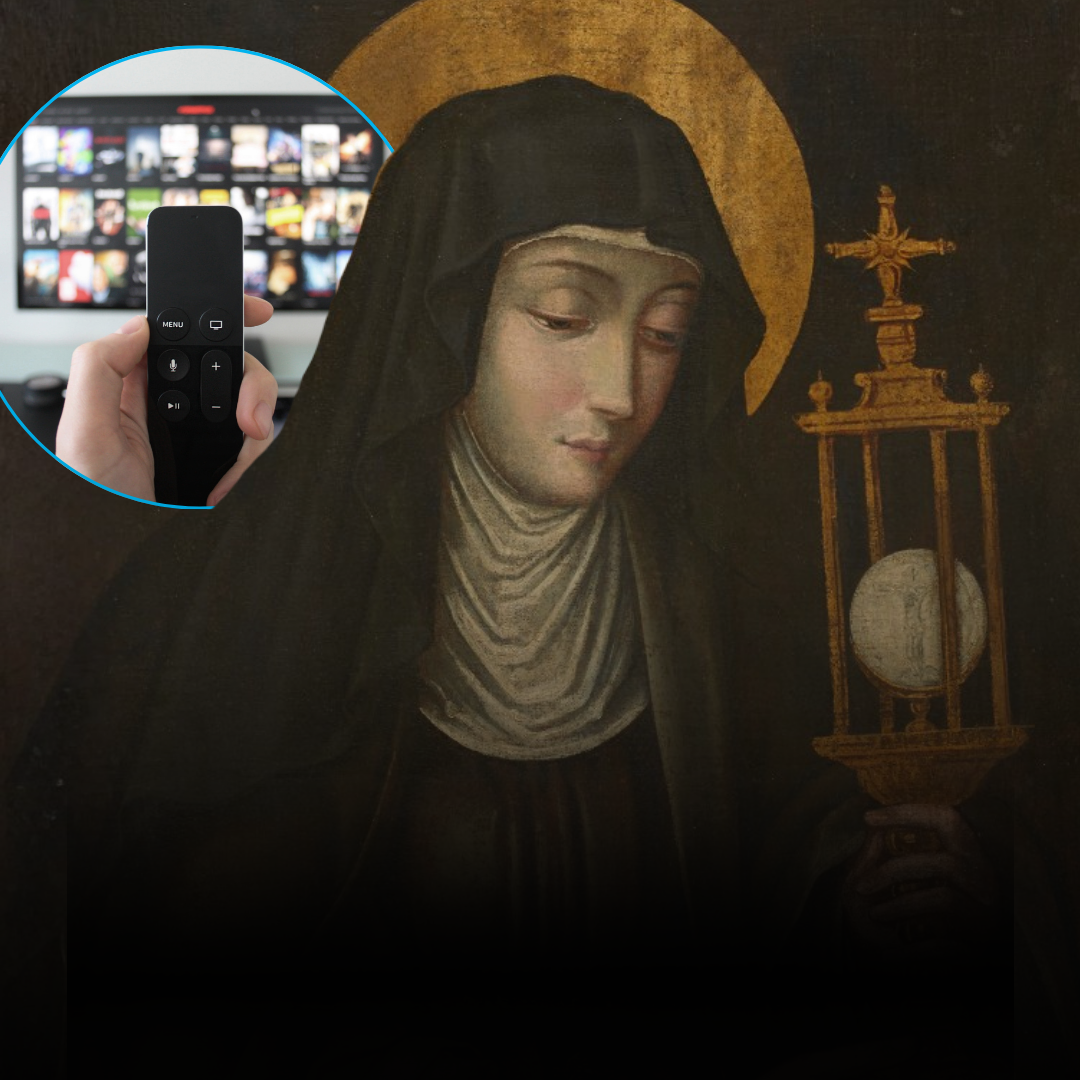
St. Clare of Assisi died on August 11, 1253. Pope Innocent IV entrusted Bishop Bartholomew of Spoleto with the responsibility of promoting the cause of her canonization. Three months later, on November 24, 1253, Bishop Bartholomew, together with the archdeacon, Leonardo of Spoleto; Jacobo, the archpriest of Trevi; Brothers Leo and Angelo, close friends of St. Francis; Brother Mark, chaplain of the monastery; and a notary went to the Monastery of San Damiano in Assisi and officially interviewed under oath thirteen of the sisters who had lived with St. Clare.
Three of them, Sister Philippa, Sister Amata, and Sister Balvina, all related the following event. Here is Sister Philippa’s testimony from “The Acts of the Process of Canonization”:
“The Lady Clare narrated how on the most recent night of the Lord’s Nativity because of the serious illness she could not get up from her bed to go to the chapel. All the sisters went as usual to Matins and left her alone. The Lady said with a sigh: ‘Lord God, look, I have been left here alone with You.’ She immediately began to hear the organ, responsories, and the entire Office of the brothers in the Church of Saint Francis, as if she were present there.”
Sister Amata added that St. Clare also saw the manger of our Lord Jesus Christ. Sister Balvina added that St. Clare later said to her sisters: “You left me here alone after going to the chapel to hear Matins, but the Lord has taken good care of me because I was not able to get up from my bed.” Matins would have preceded the Midnight Mass.
On February 14, 1958, Pope Pius XII made St. Clare patroness of television. He wrote:
“The Church, which has never been against the progress of civilization, encourages inventions and discoveries, and even uses them for the propagation of truth and the extension of religion. Among such useful inventions, the television has its place; it “reproduces the sights and sounds of distant events in so vivid a manner that one would think to be actually present at them.”
Television . . . can be the source of great good, but, at the same time great evil, in view of the singular power it exercises over the very soul of the family. It behooves us, therefore, to give to this invention a heavenly safeguard, who prevents its evil and allows its good. We wish to appoint, for this patronage, St. Clare. It is said that in Assisi, one Christmas night, Clare, confined to her convent by sickness, heard the fervent hymns that attended the sacred ceremonies and saw the Mass being celebrated, as if she were present in the Franciscan church . . . In her splendor, her innocence, and her light which she throws on our darkness, may St. Clare protect this instrument and may she give to its translucence the lights of truth and virtue — the pillars of our society.
In consequence, having consulted the Sacred Congregation of Rites, . . . and after much thought, by the Apostolic power, through this letter and forever, We make, We Constitute and We declare St. Clare, virgin of Assisi, celestial patroness, after God, of television. We give her the liturgical privileges and honors that constitute such a patronage.”
One modern biography of St. Clare, in fact, recounts the vision of St. Clare under the heading: “A Televised Christmas Mass.” Mother Angelica and EWTN have brought the televised Mass for decades to multitudes of people who are homebound, imprisoned, hospitalized, and so forth, bringing them encouragement and support. It was the desire of Mother Angelica’s, and of EWTN’s staff, to give to television’s “translucence the lights of truth and virtue — the pillars of our society.”
Note: This is an excerpt taken from Fr. Joseph Wolfe’s chapter in EWTN Publishing’s new release, Italy’s Shrines and Wonders (VOL. II): Discovering Sacred Spaces and Fascinating Places in the Life of St. Francis of Assisi by Teresa Tomeo.