
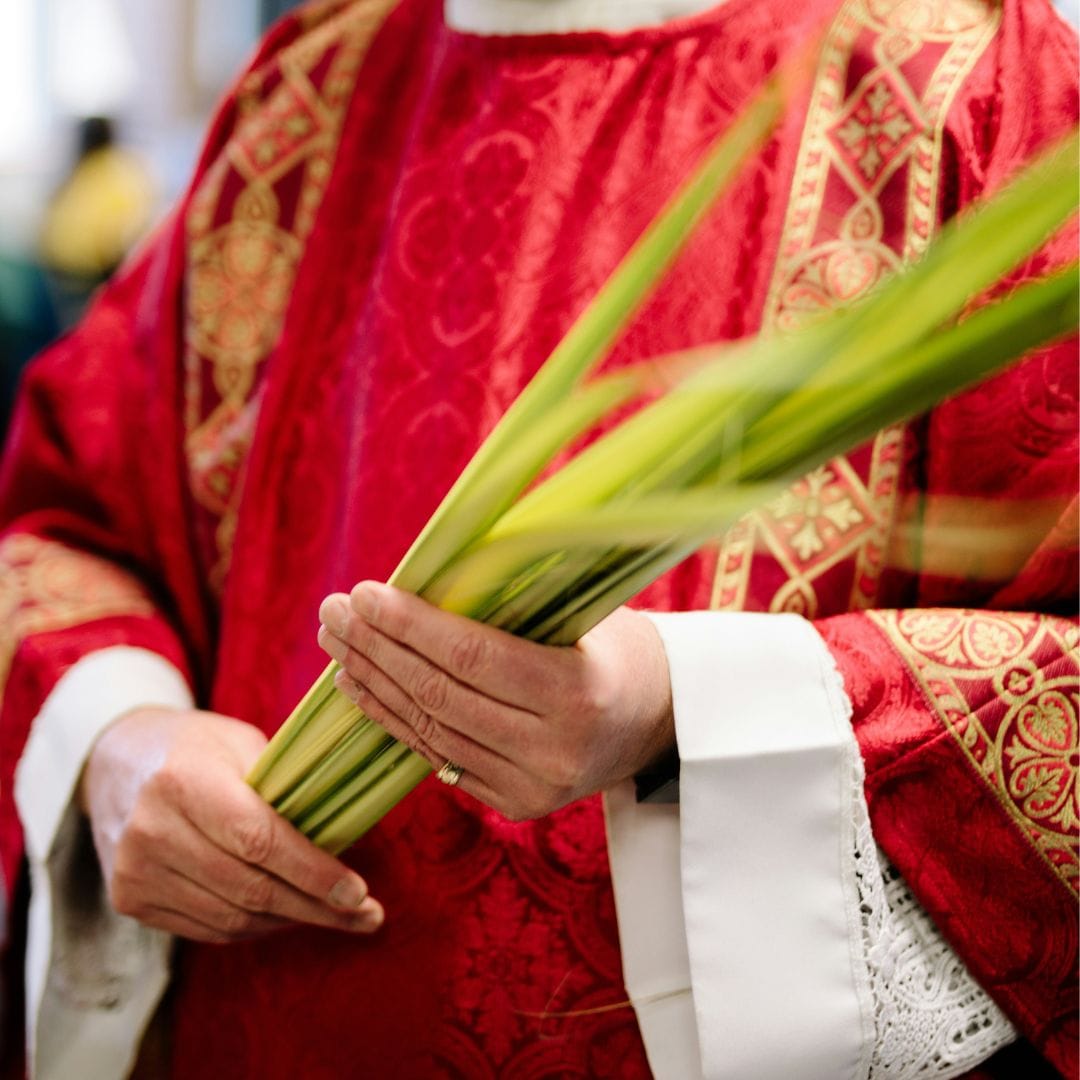
Millions of Catholics walk out of Mass holding blessed palms — but do you know what actually to do with them?
Palm Sunday is one of the most important days of the Catholic year. Nearly 18,000 Catholic parishes across the U.S. alone bless and distribute palms each year.
But here's the thing: those palms aren't just a liturgical souvenir. They're sacramentals — objects set apart and blessed by the Church to deepen our prayer life and our friendship with God. That means they deserve to be treated with real reverence.
Here's what the Church actually teaches about your blessed palms:
DO: Keep Them in Your Home as a Witness to Faith
The Vatican's Directory on Popular Piety and the Liturgy says it best: blessed palms "are kept, above all, as a testimony of faith in Christ, the messianic king, and in his Paschal Victory."
In other words, put them somewhere visible. Behind your crucifix, in your prayer corner, near the front door — anywhere that reminds you and everyone who enters your home that Christ is King.
As Pope Benedict XVI said in 2006,
"The olive branches are a sign of messianic peace, and the palm branches a sign of martyrdom — of giving one's life to God and to one's brothers."
DO: Make a Palm Cross
One of the most beloved Catholic traditions is folding your palm fronds into a small cross to display in your home. It's a simple, beautiful way to turn your sacramental into a year-round reminder of the Passion and Resurrection of Christ.
DO: Place Them With a Prayer
When you set your palms in your home, consider praying over them. ACI Prensa suggests a beautiful home blessing prayer:
"Bless, O Lord, our home. May your Son Jesus and the Virgin Mary reign in it. Give us peace, love, and respect… be You, the King of our home. Amen."
DO: Return Them to Your Parish to Become Ash Wednesday Ashes
Here's the beautiful liturgical cycle most Catholics know but rarely stop to reflect on: the ashes placed on your forehead next Ash Wednesday come from this year's blessed palms.
Per the Roman Missal, ashes are to be made from the previous year's Palm Sunday branches, which are burned into a fine powder. Your parish collects palms throughout the year for exactly this purpose. What begins as a sign of royal welcome ends as a sign of mortality and repentance — and then begins again.
DO: Burn or Bury Them If You Dispose of Them at Home
If, for any reason, you need to dispose of your blessed palms yourself, Canon Law is clear: sacred objects that are no longer being used must be burned or buried — not thrown away. The ashes can then be buried in the earth.
DON'T: Throw Them in the Trash
This is the big one. Do not throw your blessed palms in the garbage. Canon Law 1171 requires that all blessed objects be treated with reverence — and if they must be disposed of, they should be burned or buried, not discarded like ordinary waste.
DON'T: Use Them as Amulets or for Superstitious Purposes
This one might surprise you. The Vatican's Directory on Popular Piety and the Liturgy explicitly warns that palms should not be kept "as if they were amulets, for curative purposes, or to keep evil spirits at bay."
Sacramentals derive their spiritual power from the Church's prayer and the faith of the person using them, not from any magical property in the object itself. Your palms are not a lucky charm. They are a call to faith.
DON'T: Treat Them Like Ordinary Objects
As Thomas Craughwell writes at the National Catholic Register, blessed sacramentals "deepen our life of prayer, while intensifying our friendship with Almighty God and His saints..."
They are not ordinary. The blessing the priest prayed over them at Mass matters. Handle them accordingly.
DON'T: Just "Pick Up" the Palms Without Entering the Liturgy
The palms are not the point — the procession and the Mass are. The palms are a beautiful sign of our participation in Christ's triumphal entry into Jerusalem and His journey toward the Cross. Going only to collect the palms without entering fully into the liturgy misses the whole meaning.
Your blessed palms are a small but powerful sign of the Paschal Mystery.
From Palm Sunday to Ash Wednesday, they trace the arc from triumph to death to new life — the same arc we are all called to walk with Christ.