
To say that Christendom was in dire straits would be an understatement.
In the late 16th century, Christian Europe was weak and divided. Politically, Europe was just a collection of small, warring kingdoms.
The Protestant Reformation broke their fragile unity in the Catholic faith, which was now in full swing across the continent.
Meanwhile, the Ottoman Empire, was strong and growing, having not lost a significant naval battle in a hundred years. Its forces had already conquered the remains of the eastern half of the Roman Empire, including “New Rome” Constantinople.
Now, their seemingly unstoppable forces set their sights on conquering Rome, and from there, the rest of Europe and the New World.
Desperate for survival, Pope Saint Pius V convinced as many Catholic rulers of the Mediterranean as possible to band together to stop the Ottomans, forming what they called the Holy League.
The Holy League was initially formed to save a Venetian colony on Cyprus that was under Ottoman attack, but the colony fell before they arrived.
The Ottoman commander captured the Venetian leader, had him flayed alive, and hung up his corpse along with the corpses of other Venetian leaders. So the Holy League sailed to meet the Ottoman navy at their base in Lepanto, Greece, instead.
The odds were against the Holy League: Despite the fact that many nations banded together in the Holy League, the Ottoman forces still had more boats and were practiced in fighting together, rather than being cobbled together just for the occasion.
The stakes were high: if the Holy League failed, the Ottomans would appear to have a clear way to the heart of Europe in Rome.
Knowing the desperate circumstances, Pope Saint Pius V did the only thing those back at home could do: pray.
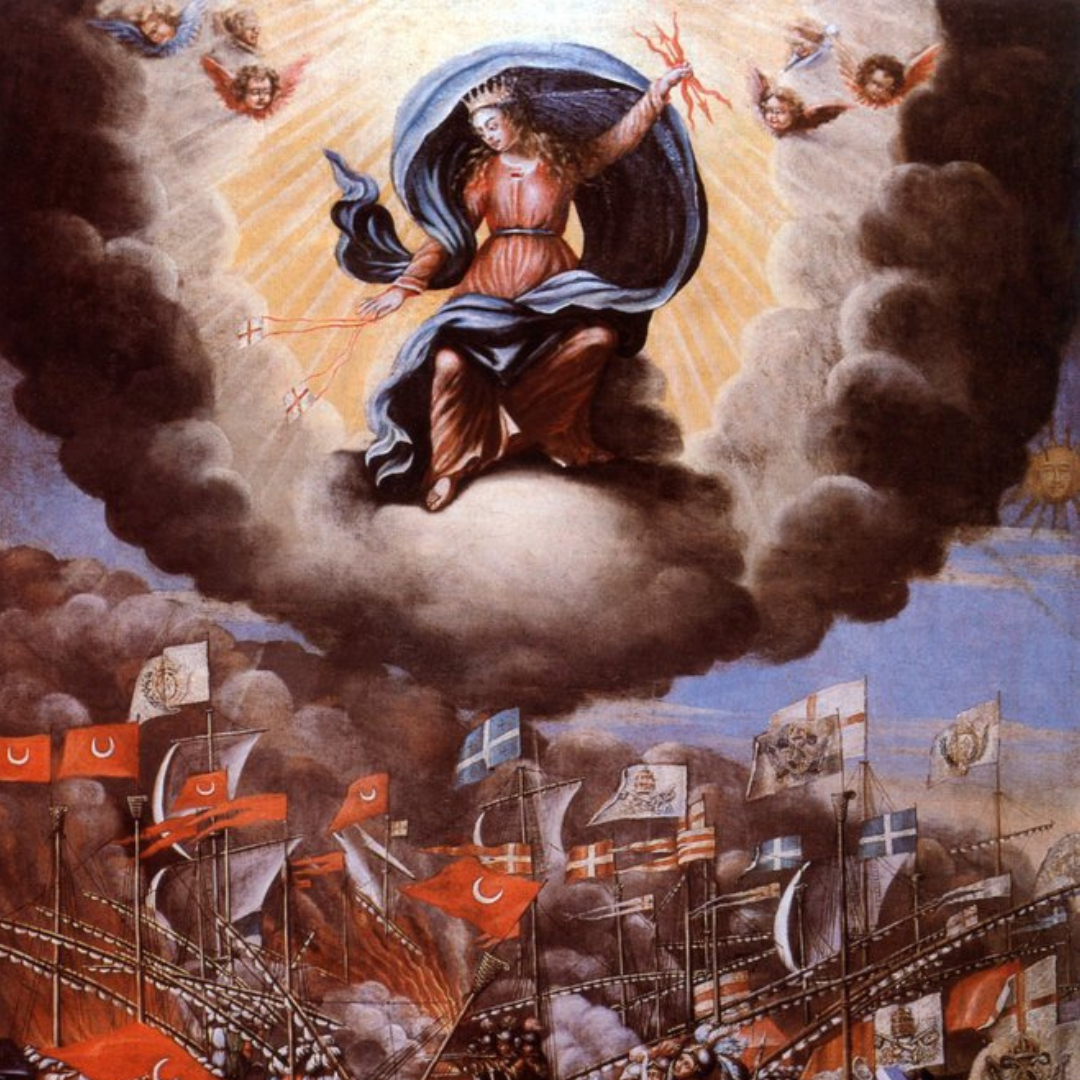
On October 7, 1571, the day of the battle, he organized a public procession in Rome to pray the Rosary.
Then a miracle happened: they received word that, against all odds, the Holy League won!
Overjoyed and convinced that their prayers were decisive, the Pope created the new Feast of Our Lady of Victory.
A few years later, it was renamed to the Feast of the Holy Rosary, and eventually, in the 20th century, became known as the Feast of Our Lady of the Rosary, which it remains today. The Church celebrates this feast on Oct. 7.
Historians say that the Battle of Lepanto truly was decisive in world history: it once and for all stopped the advancement of Ottoman forces deeper into Europe, preserving the independence of the western half of Christendom.