

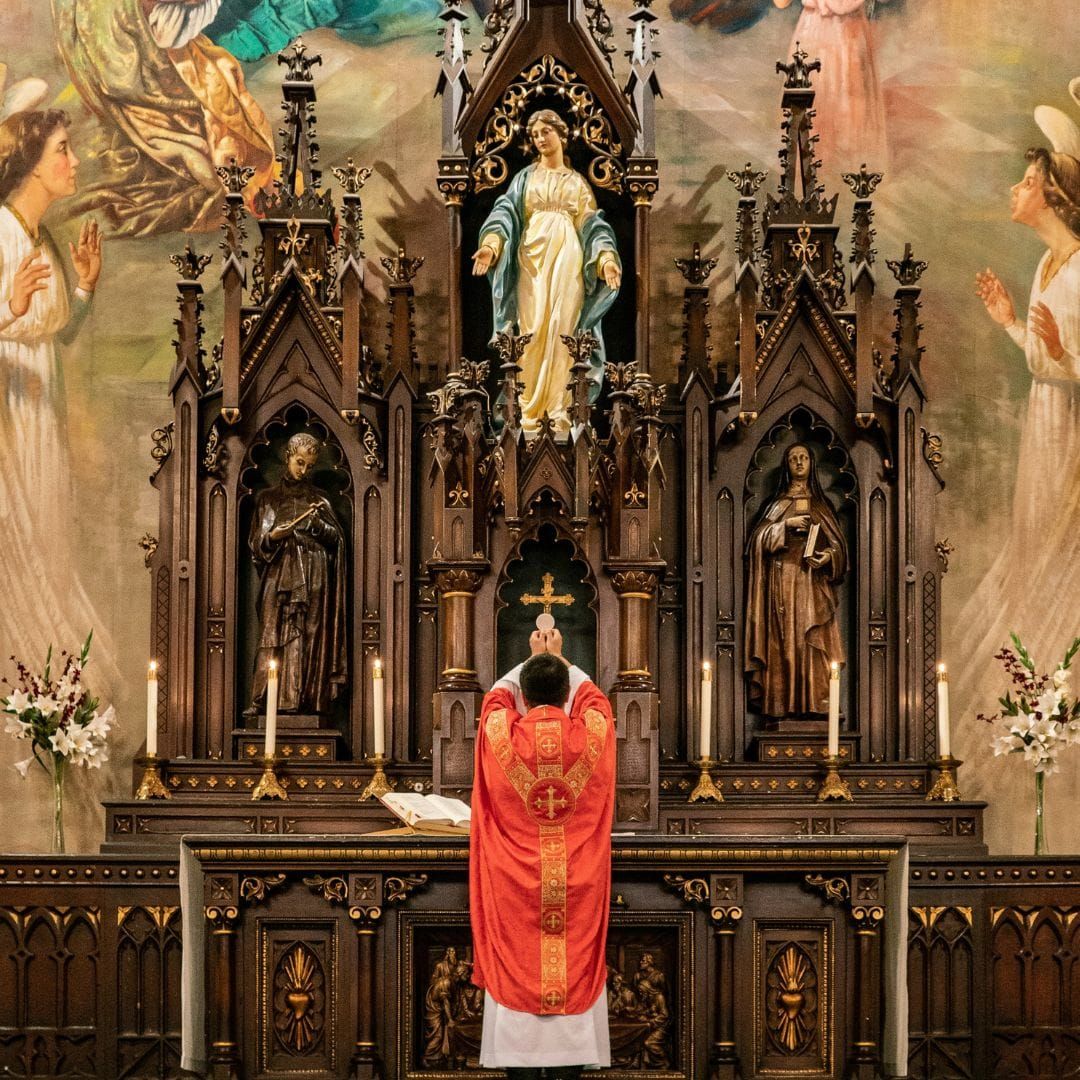
The Church has always sought to draw us into the depths of the mystery of the Eucharist. Yet we sometimes pay little attention to what truly takes place and allow ourselves to be distracted by external elements that are not essential.
To fully benefit from it, we must recover what Cardinal Raniero Cantalamessa calls “Eucharistic wonder”—the ability to be amazed anew by the “enormity” (as Claudel describes it) of the Eucharist.
We do not go to Mass simply out of habit or because it is a repeated ritual. We go because there we encounter the living Christ—an invitation to pause and allow Him to transform our hearts.
Here are five powerful ways to experience the Mass more deeply every time you go:
1) Prepare before arriving.
Mass begins long before we enter the church. Taking a few minutes beforehand—in silence, with a brief prayer, or by reading the day’s readings—can open our hearts and prepare our souls. Arriving early helps us leave behind the noise of the world and remember Whom we are about to encounter.
2) Participate with our whole being.
It is not enough to be physically present. Let us sing, respond, listen attentively, and offer our intentions. Every gesture and every word carries profound meaning. When we participate actively, the Mass ceases to be something we merely “watch” and becomes something we truly live.
3) Listen to the Word as if it were meant for you.
Because it is. God speaks personally through the readings and the homily. A helpful question to ask is: What is the Lord saying to me today? Sometimes a single sentence can illuminate a situation in our lives. By listening attentively, we allow ourselves to be touched by the Word’s relevance here and now.
In the liturgy, Scripture takes on a deeper meaning than when read in other contexts. Like the disciples on the road to Emmaus, whose hearts were stirred as the Scriptures were explained, we too are prepared to recognize Jesus in the breaking of the bread. The Word prepares us to receive Him in Holy Communion.
4) Offer our lives.
When the bread and wine are brought to the altar, let us also offer our joys, struggles, worries, and gratitude. Let us unite our lives to Christ’s sacrifice. Nothing we carry in our hearts is insignificant to God.
At the offertory and consecration, there are two “bodies” of Christ on the altar: His real Body (born of the Virgin Mary) and His mystical Body, the Church. There, we are inseparably united.
In the great "I" of the Head, the small "I" of the body, which is the Church, is hidden. Our offering, and that of the Church, would be nothing without Christ’s; yet Christ’s offering is not complete without the participation of His Body.
Each of us can ask: What do I offer when I unite myself to Jesus in the Mass?
5) Our whole life becomes a Eucharist.
The atheist philosopher Ludwig Feuerbach once said, “Man is what he eats.” Through the Eucharist, this becomes profoundly true for Christians. We do not assimilate Christ; rather, He assimilates us into His Body. The flesh of Christ becomes ours—and our humanity becomes His.
This reveals a powerful truth: nothing in our lives lies outside of Christ. In an entirely undeserved exchange, we give Him our weariness, pain, failures, joys, and sins—and in return, we receive nothing less than Himself. This is the “enormity” of the Eucharist.
We are all united in Christ, and Christ lives in each of us. That is why we can truly call one another brothers and sisters. When we say “Amen” at Communion, we say “Amen” not only to the Body of Christ given for us, but also to His Body, the Church—all those around us.