
We are living in the midst of a quiet but unmistakable liturgical revival in the United States.
Across college campuses, in growing parishes, and within online communities, young people are turning with new enthusiasm to Catholic and Orthodox traditions that only a generation ago were often overlooked in Western society.
They are drawn not by novelty, but by something ancient—incense curling upward like prayer, the steady rhythm of the rosary beads, the resonance of Latin, and, above all, the sound of Gregorian Chant.
This return is not accidental. In an age of distraction and constant noise, the human heart longs for silence and transcendence.
Gregorian Chant, the Church’s native song, speaks precisely to that longing. Its flowing melodies, free from strict meter and rhythm, seem to step outside of time. They lift us beyond the here and now into the eternal.
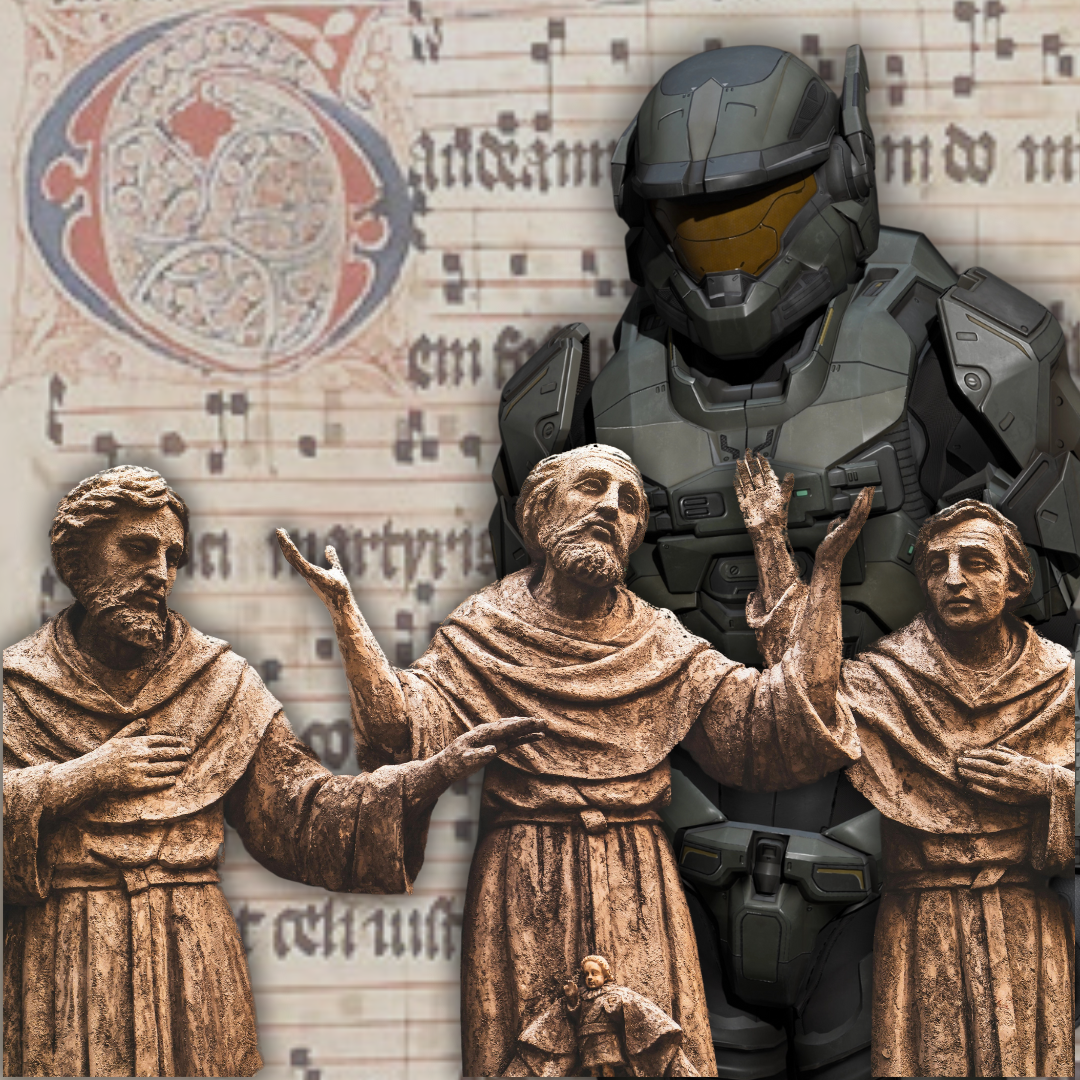
Even secular culture recognizes this quality. For decades, Hollywood has used chant to signal the mysterious, the sacred, or the transcendent. A striking example is found in one of the most popular video games of all time: Halo.
Halo and the Sound of Timelessness
First released in 2001 by Bungie Studios as an exclusive title for Microsoft’s new Xbox console, Halo: Combat Evolved became a cultural phenomenon. It transformed the landscape of video gaming, introducing players to a vast science fiction universe, cinematic storytelling, and multiplayer battles that set the standard for years to come.
But beyond its gameplay, Halo became instantly recognizable for its music.
The main theme, composed by Martin O’Donnell and Michael Salvatori, begins with an unmistakable use of Gregorian Chant. Male voices intone in Latin-inspired syllables, creating an immediate sense of mystery and majesty. The choice was deliberate: O’Donnell later said he wanted something “monastic, timeless, and otherworldly” to capture the vastness of space and the grandeur of humanity’s struggle.
The result was iconic. Players around the world, many with little or no exposure to sacred music, associated chant with awe, transcendence, and mystery. The soundtrack helped shape the emotional world of Halo and remains one of the most memorable video game scores in history.
Today, many people in secular society hear Gregorian Chant and immediately think it’s the Halo soundtrack. On my own YouTube Channel, after uploading a YouTube Short accompanied by Gregorian Chant, a viewer commented, “Nice use of the Halo Soundtrack.” In reality, it was a recording of the Monks of Solemnes chanting a proper antiphon for Mass.
Chant Belongs in the Liturgy
And here is the irony: while Gregorian Chant was captivating millions of gamers, it was often absent from the place where it most properly belongs—the Sacred Liturgy. In too many parishes, chant was replaced with popular styles or settings that, while not inherently illicit, lack the depth and universality of the Church’s own tradition.
The Second Vatican Council was clear:
“The Church acknowledges Gregorian chant as proper to the Roman liturgy: therefore, other things being equal, it should be given pride of place in liturgical services” (Sacrosanctum Concilium, 116).
Far from sidelining chant, the Council fathers envisioned its renewal and wider use. Pope Paul VI himself issued the booklet Jubilate Deo in 1974, offering a simple repertoire of chants so that every Catholic could sing them. Fifty years later, can every Catholic sing them? No.
Saint John Paul II reiterated this vision:
“The more closely a composition for church approaches in its movement, inspiration and savor the Gregorian form, the more sacred and liturgical it becomes” (Chirograph on Sacred Music, 2003).
Benedict XVI likewise emphasized chant’s role, calling it “a supreme model of sacred music” (Sacramentum Caritatis, 42).
When chant is sung at Mass—whether the Introit, the Kyrie, or the Communion antiphon—it does not merely decorate the liturgy; it is the liturgy. It is prayer, sung. It unites the faithful across languages and centuries. It embodies the universality of the Church, speaking in tones that reach the soul even when the words are not understood.
A Call to Recovery
If popular culture has instinctively turned to Gregorian Chant to conjure timelessness, how much more should the Church recover it for the worship of the Eternal God? The fascination of young people with incense, rosaries, and chant is not nostalgia—it is a yearning for the sacred. They are seeking what the Mass is meant to offer: a foretaste of heaven.
The task before us is not to create something new, but to reclaim what has always been ours. Gregorian Chant should not be left as a background track for video games, films, or commercials. Its proper home is the Holy Sacrifice of the Mass, where heaven meets earth.
As Pope Benedict XVI wrote,
“An authentic updating of sacred music can take place only in the lineage of the great tradition of the past, of Gregorian chant and sacred polyphony” (Sacramentum Caritatis, 42).
In other words, true renewal is never rupture—it is continuity.
The cultural success of Halo shows that even secular audiences recognize the transcendent power of chant.
Now is the time to lead people from the echoes of that power in popular culture back to its source: the worship of the living God.
If we do, Gregorian Chant will no longer be a borrowed symbol of mystery in the world’s entertainment, but once again the living voice of the Bride singing to her Bridegroom in the sacred liturgy.