

Every December, families across the world revisit the holiday classic Home Alone, a film remembered mostly for slapstick humor, flying paint cans, and the brilliant resourcefulness of young Kevin McCallister.
Yet behind the laughter lies a surprisingly profound message about loneliness, fear, reconciliation, and the longing for restored relationships.
Beneath its comedic surface, Home Alone subtly mirrors a central truth of the Catholic faith: our deep need for healing, mercy, and reunion through the Sacrament of Confession.
At the beginning of the film, Kevin McCallister finds himself in an extraordinary situation. Accidentally left behind as his family flies to Paris, he wakes up to discover that he is completely alone.
At first, it is a dream come true. No parents to correct him, no siblings to bully him, no rules to follow. Kevin revels in his newfound independence—eating ice cream for dinner, watching movies he’s not allowed to see, and jumping on his parents’ bed. For a fleeting moment, total freedom feels exhilarating.
But as the days pass, Kevin’s joy fades. The silence of the house becomes heavy. The laughter, warmth, and familiarity of his family—so irritating just a few days earlier—are now deeply missed.
He realizes that independence without love is empty. His heart aches for home, for forgiveness, and for communion with those he loves. In this way, Kevin experiences what every human soul eventually comes to realize: we were not created for isolation.
Pope Benedict XVI once wrote,
“Man is not a self-sufficient cosmos… We are made for communion, for relationship, for love.”
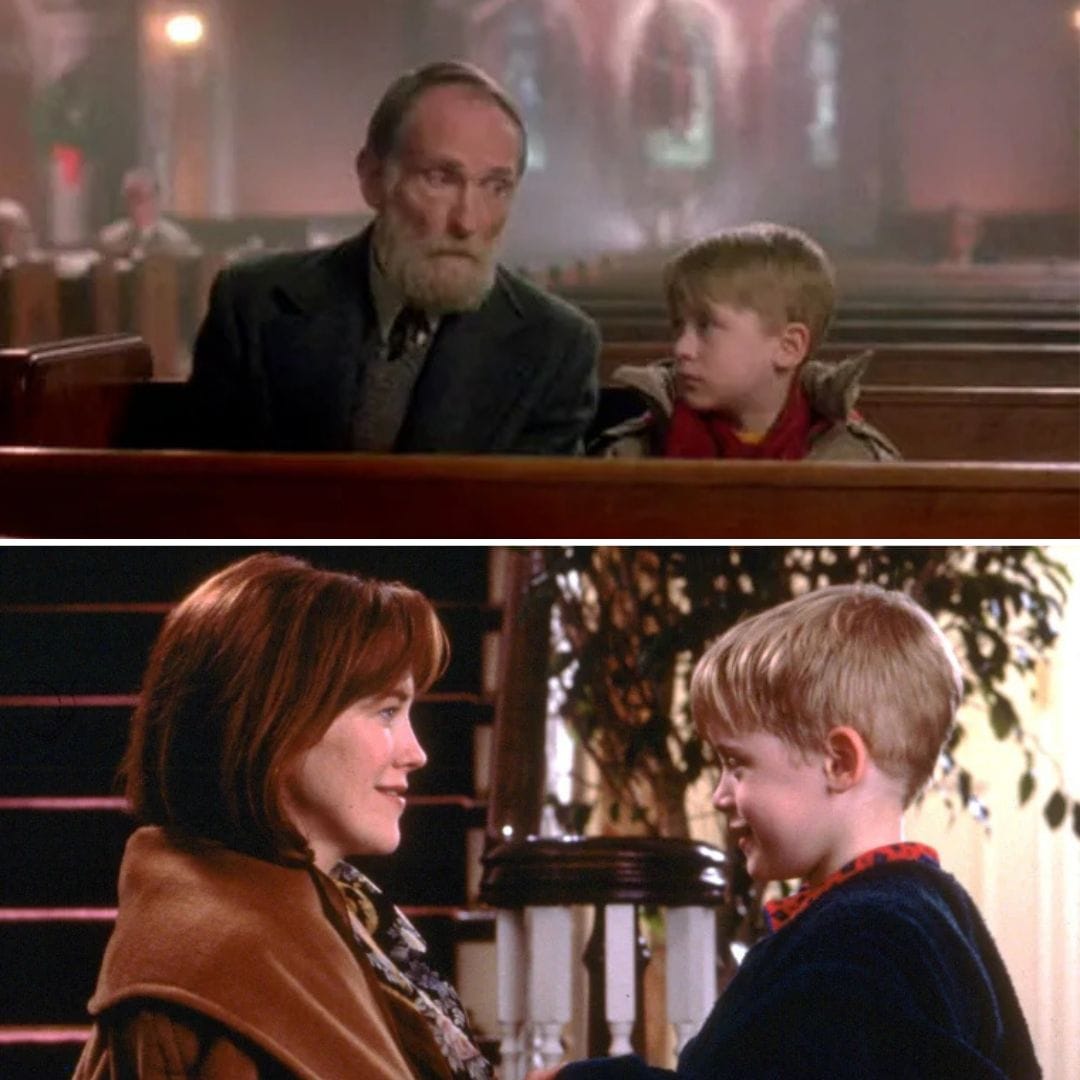
It’s no coincidence that Kevin’s metanoia (μετάνοια, Greek for “change of heart”) takes place not in his house but in a place of profound spiritual refuge—his local church. Seeking respite from fear and loneliness, Kevin steps inside on a snowy evening and quietly takes a seat. A children’s choir rehearses O Holy Night, their innocent voices filling the sanctuary with peace.
It is not merely a beautiful movie moment; it is a cinematic reminder that the Church is a place of solace, especially when our hearts are confused or burdened.
There, Kevin meets “Old Man Marley,” a neighbor rumored to be dangerous and unfriendly. In reality, Marley is gentle, sorrowful, and carrying a heavy burden of his own. The two strike up a sincere conversation—an exchange that feels almost sacramental.
Marley confides that he is estranged from his son, separated by pride, anger, and fear. Kevin, too, confesses his failings: his harsh words to his family, his stubbornness, and the ways he took their love for granted. In that quiet church, both open their hearts.
The scene strongly resembles Confession. Saint John Paul II described Confession as the place where “the sinner experiences the merciful embrace of the Father.” This is exactly what Marley and Kevin seek—mercy, belonging, reconciliation.
Their conversation becomes a moment of grace. Each encourages the other toward courage and forgiveness. In a sense, they serve as instruments of God’s compassion for one another.
Their decisions bear fruit. Marley’s reunion with his son—shown in a silent, moving scene on Christmas morning—captures the joy that follows authentic reconciliation. The embrace, the smiles, the restored bond: it is a glimpse of what every soul experiences after absolution.
As Jesus teaches in the parable of the Prodigal Son,
“There will be more joy in heaven over one sinner who repents than over ninety-nine righteous persons who need no repentance” (Luke 15:7).
Kevin, too, is rewarded with reconciliation. When his mother bursts through the door and embraces him with tears of relief, the miracle of forgiveness becomes visible. Kevin does not earn his family’s love—he receives it freely, just as the penitent receives the mercy of God in the confessional.
In that moment, Kevin experiences what the Catechism calls “a restoration of the dignity and blessings of the life of the children of God.”
The beauty of Confession is that it is not merely a moment of personal cleansing, but a sacrament that restores relationships—with God and with others. It heals the wounds of sin, softens hard hearts, and gives families the grace to forgive.
As Saint Augustine wrote,
“God never tires of forgiving us; it is we who tire of asking.”
Home Alone reminds us that reconciliation is always possible, even after misunderstandings, mistakes, or painful silence.
As Christmas approaches, Kevin and Old Man Marley offer us an invitation. No matter how long we’ve been away, no matter how complicated our relationships have become, there is a place where healing begins. It is the quiet of the confessional, where Christ waits to restore us with the words, “Go in peace.”