

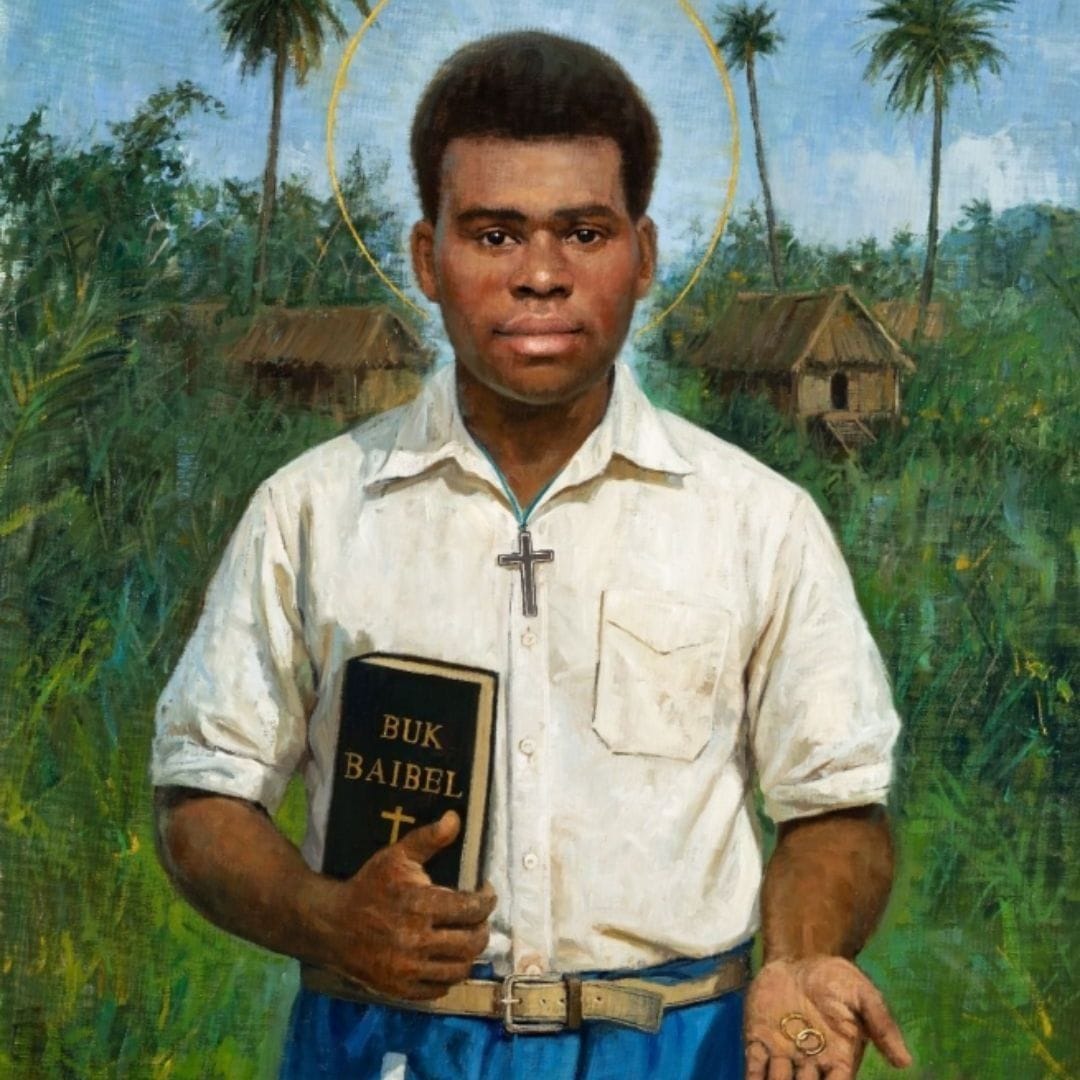
Peter To Rot was a young catechist who stood up to the Japanese authorities during World War II in defense of the indissolubility of marriage. His unwavering faith led him to martyrdom, and he has now been canonized as Papua New Guinea’s first saint.
On October 19, Pope Leo XIV canonized seven new saints, including the former Satanist and apostle of the Rosary, Bartolo Longo; the “doctor of the poor,” José Gregorio Hernández; and the Venezuelan nun Carmen Rendiles, who was born with a disability.
However, though less well-known, the testimony of Peter To Rot deserves special recognition. A husband, father, catechist, and martyr, he gave his life at just 33 years old to defend the sanctity of marriage.
Who was Peter To Rot?
Peter To Rot was born in 1912 in the small village of Rakunai, now part of Papua New Guinea. He was the son of Angelo To Puia, a tribal chief, and Maria Ia Tumul, both baptized as adults and among the first generation of Christians in the country.
From a very young age, Peter felt called to serve God and his community. At 18, he entered catechist school, and at 21, he officially began his pastoral ministry. In 1936, he married Paula Ia Varpit, with whom he had three children. His family life and ministry made him a model of faith for his people.
When Japanese troops occupied Papua New Guinea in 1942, they imprisoned all foreign missionaries. In the absence of priests, Peter courageously took up the spiritual leadership of his community.
“He spent his time visiting the sick, baptizing children, praying with the community, preparing couples for marriage, burying the dead, and distributing Holy Communion. He often walked more than five or six hours to clandestinely reach the prison where the missionaries were detained and receive the consecrated hosts, which he then secretly distributed among the faithful,” the Dicastery for the Causes of Saints states.
A martyr for the fidelity of marriage
In 1944, when the Japanese authorities re-legalized polygamy to gain favor with local leaders, Peter publicly opposed the practice. He denounced it as contrary to the Gospel and urged Catholics to resist, fully aware that his stance could cost him his life.
"He understood and taught that marital union, by its very nature, requires the indissolubility of the bond and the unity of the spouses for life," the dicastery adds.
His steadfastness angered both the authorities and some tribal leaders. He was arrested multiple times, threatened, and pressured to abandon his ministry—but he refused to budge. In 1945, he was finally imprisoned.
“On the night of July 7, 1945, two Japanese doctors visited the catechist in his cell. One of them gave him an injection and told him to lie down. After a while, Peter To Rot began to thrash and seemed to want to vomit. The doctor covered his mouth and held him still until he breathed his last.”
After his death, his tomb in Rakunai became a place of pilgrimage. The faithful inscribed the cross marking his grave with the words:
“To Rot. Martyr for the faith.”