

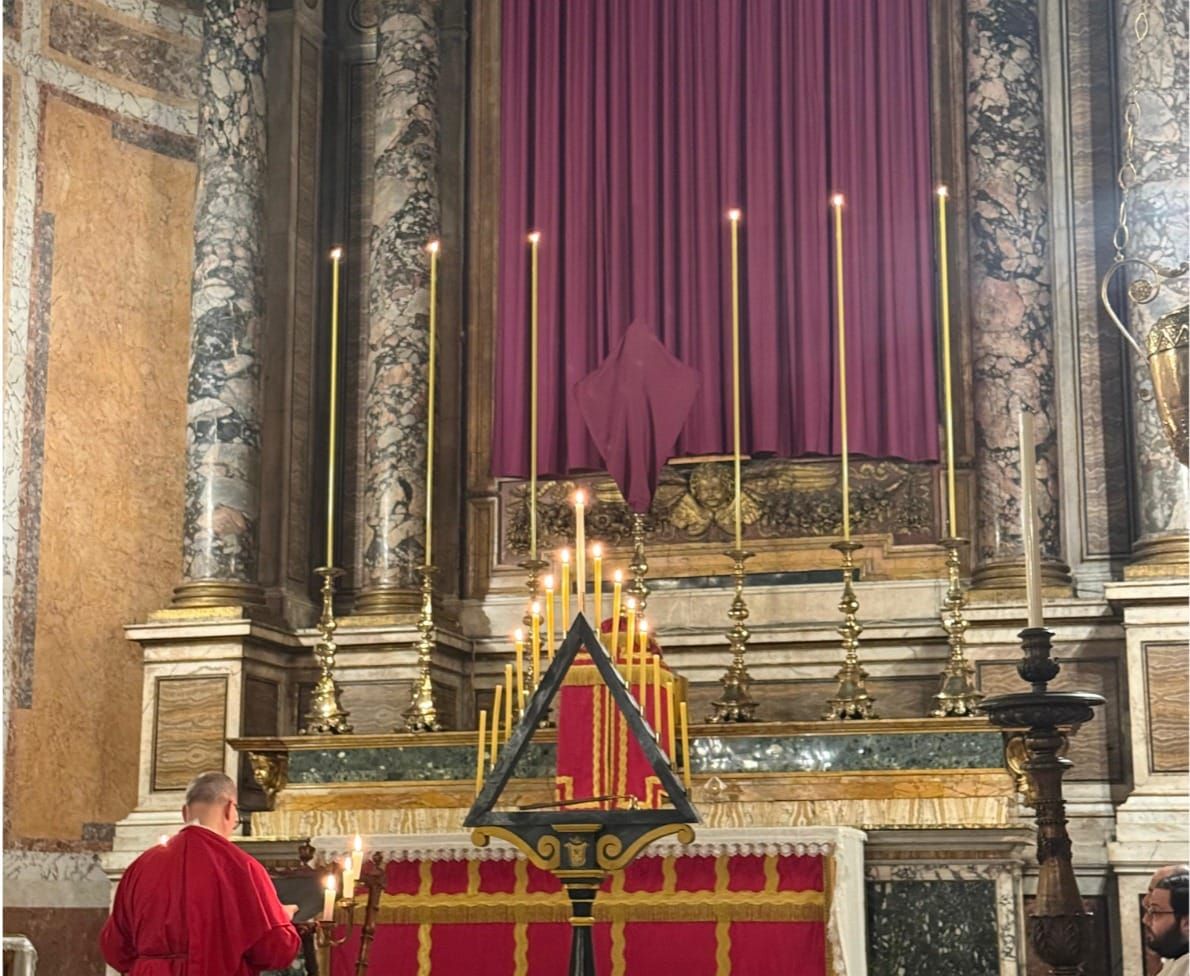
A custom in many churches during Lent is to cover statues, images, and crucifixes with a purple cloth. This is the tradition of velatio, Latin for "veiling."
The goal, according to Father Rafhael Silva Maciel, from the Archdiocese of Fortaleza (CE), is to focus attention on Jesus.
“This custom shows that all the beauty of the images is hidden so that nothing can distract the faithful from Christ, who will begin his journey of the cross to Calvary on Good Friday,” the priest, a Doctor of Liturgy from the Pontifical Institute of St. Anselm in Rome, told ACI Digital.
The priest said that the images are covered starting on the fifth Sunday of Lent.
The velatio ( lighting of the candles) was obligatory before the liturgical reforms of the Second Vatican Council. Afterwards, with the missal of Paul VI, it ceased to be obligatory.
“The practice of covering crosses and images in the church, from the Fifth Sunday of Lent onwards, may be maintained according to the disposition of the Episcopal Conference. The crosses remain covered until the end of the celebration of the Passion of the Lord on Good Friday; the images until the beginning of the Easter Vigil,” says the circular letter Paschalis sollemnitatis, from the Congregation (now dicastery) for Divine Worship of the Holy See, citing a rubric from the missal.
According to Father Rafhael, in addition to focusing the attention of the faithful on Christ, "by covering the images the Church anticipates, in some way, the mourning for the Lord's death, seeking to instill in the faithful, also, a mortification of their vision."
Regarding the color of the cloth, he emphasized that it should be purple, "the penitential color of Lent, which ordained ministers wear in their vestments, and signifies the expectation of new life."